 Call
Call Patient Reports
- Cardiology 84
- Dermatology 45
- Endocrinology 33
- ENT 16
- Fertility 190
- Gastroenterology 78
- General-Medicine 81
- Gynecology 80
- Hematology 19
- Infectious-Diseases 33
- Neurology 52
- Oncology 34
- Ophthalmology 23
- Orthopedics 69
- Pediatrics 31
- Procedure 23
- Public-Health 144
- Pulmonology 59
- Radiology 8
- Urology 68
- Wellness 161
- Woman-and-child 77

- 1128
- 1.9 Minute
Written by Medicover Team and Medically Reviewed by Dr Yevvari Sameera, Consultant Radiologist
PET CT Scan Types and Therapies
A PET-CT scan is an advanced imaging test that combines two powerful scans. Positron Emission Tomography and Computed Tomography (PET CT) combines both technologies into a single test. The CT part shows detailed images of organs. The PET part shows how active or "working" those tissues are, using a very small amount of radioactive tracer.
Different types of PET CT scans use different tracers. Each tracer is designed to "highlight" a specific disease process, such as cancer spread, bone changes, blood flow to the heart muscle, or brain changes. Because of this, doctors don't use the same PET CT scan for every condition. The choice depends on the clinical question.
This guide explains the types of PET CT scans that are commonly used and the related PET CT scan treatments. It is intended to help you understand what each scan does, when it is used, and how it supports treatment decisions.
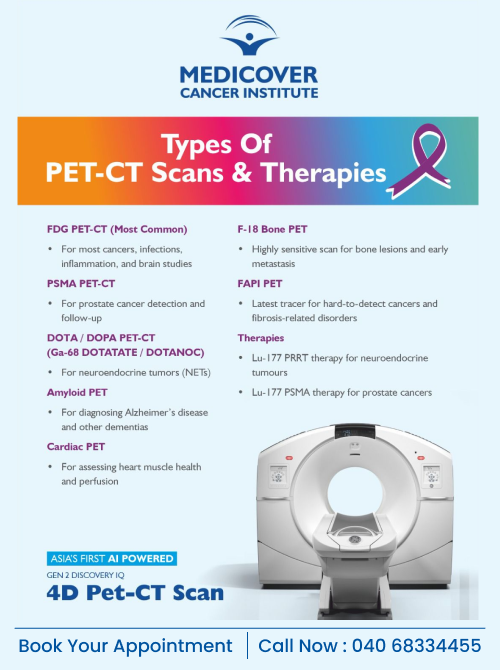
Different Types of PET CT Scans
FDG PET CT
FDG PET CT is a widely used PET CT scan worldwide. It uses a tracer called 18F-FDG, which is a radioactive form of glucose (sugar). Many cancers use more glucose than normal tissues. Because of this, FDG PET CT can show areas of unusually high metabolic activity in the body.
FDG PET CT is commonly used in oncology to:
- Detect the primary cancer and any spread (staging)
- Check whether treatment (chemotherapy, radiation, targeted therapy) is working
- Look for suspected recurrence when tumor markers increase or symptoms return
- In some cases, distinguish scar tissue from active disease
Beyond cancer, FDG PET CT can also be helpful in selected cases of infection and inflammation, such as fever of unknown origin or suspected vasculitis, because inflamed tissues also take up more glucose.
PSMA PET CT
PSMA PET CT is primarily designed for prostate cancer. PSMA stands for prostate-specific membrane antigen, a protein found in high levels on the surface of many prostate cancer cells. Special tracers (such as Ga-68 PSMA-11 or the newer F-18 PSMA agents) bind to this protein, making PSMA-positive lesions visible on PET images.
PSMA PET CT is particularly useful for:
- Newly diagnosed intermediate- or high-risk stage prostate cancer
- Look for spread to lymph nodes and bones
- Detect recurrence when PSA rises after surgery or radiation
- Guide treatment planning, including surgery, radiation fields, or systemic therapy
Studies have shown that PSMA PET CT can detect small metastatic deposits that are often missed by conventional CT, MRI, or bone scans. This could change the treatment plan in a significant number of patients, as the exact locations of the disease are well defined.
Get a second opinion from trusted experts and makeconfident, informed decisions.
Get Second OpinionNot sure where to start?
Talk to a patient care advisor — free, confidential, 24/7. We'll match you to the right specialist and book your appointment in minutes.
DOTA / DOPA PET-CT
DOTA PET-CT (as Ga-68 DOTATATE, DOTATOC, or DOTANOC) is primarily used to image neuroendocrine tumors (NETs). These tumors often express high levels of somatostatin receptors on their cell surfaces. DOTA tracers are somatostatin analogs that have been linked to a gallium-68 label, which allows receptor-positive disease to be shown on PET CT.
This type of PET CT scan can help:
- Identify primary NETs when the origin is unclear
- Evaluate the extent of the disease (lymph nodes, liver, bone, etc.)
- Assess suitability for somatostatin analog therapy or peptide receptor radionuclide therapy (PRRT)
- Monitor response to treatment and detect progression
DOPA PET-CT (using tracers such as F-18 DOPA) can be used for some neuroendocrine tumors and certain neurological conditions. It targets amino acid pathways in cells and is useful in cases where FDG or DOTA-based scans are less informative.
DOTA PET-CT has largely replaced older imaging modalities such as traditional octreotide scans in many centers because it offers higher sensitivity and better spatial resolution. It is also used as the tool of choice for treatments such as Lu-177 PRRT, where the same receptors are targeted for treatment.
FAPI PET
FAPI PET uses tracers that target fibroblast activation protein (FAP). FAP is expressed on cancer-associated fibroblasts in many tumors and in some fibrotic or inflammatory conditions. Because of this, FAPI PET can show lesions even when FDG uptake is low or nonspecific.
- Imaging a wide range of solid tumors, including those that are sometimes difficult to see on FDG PET
- Evaluating peritoneal disease, pancreatic cancer, some liver lesions, and other sites with fibrotic stroma
- Potentially predicting noncancerous fibrotic or inflammatory diseases in the future
FAPI PET is an emerging type of PET CT scan and is not yet universally available or integrated into all guideline-based pathways. Many centers are using it in research settings or in selected clinical scenarios. So far, the results are promising, with good lesion-to-background contrast and the possibility of "theranostic" applications, where similar compounds could be used for both imaging and targeted radionuclide therapy.
Your health is everything - prioritize your well-being today.
Schedule Your AppointmentAmyloid PET
Amyloid PET is primarily used in neurodegenerative conditions, particularly suspected Alzheimer's disease. Tracers bind to beta-amyloid plaques in the brain. PET CT images show whether there is a significant plaque burden.
This scan can help:
- Support or exclude a diagnosis of Alzheimer's disease in complex cases
- Distinguish Alzheimer's disease from certain other causes of cognitive decline
- Guide the inclusion of patients in certain clinical trials and emerging therapeutic avenues
It is important to understand that a positive amyloid PET result does not confirm that Alzheimer's disease is the cause of symptoms. Some older adults may have amyloid deposits without significant cognitive impairment. This is one of the unique types of PET CT scans that can help make a more accurate diagnosis, which can be crucial when planning long-term care and considering disease-modifying treatments.
Cardiac PET
Cardiac PET focuses on the heart. Various tracers can be used to assess blood flow (myocardial perfusion), metabolism (such as glucose utilization with FDG), or specific inflammatory processes.
Common uses of cardiac PET:
- Myocardial perfusion PET: Measures blood flow to the heart muscle at rest and during stress. It can help diagnose coronary artery disease and assess its severity.
- Myocardial viability FDG PET: Checks whether areas of weakened heart muscle are still alive and improving after revascularization procedures such as angioplasty or bypass surgery.
Assessment of cardiac sarcoidosis or other inflammatory cardiomyopathies, where FDG uptake patterns show active inflammation.
Cardiac PET provides high image quality and accurate quantification of blood flow. This is particularly helpful when other tests (such as stress echocardiography or SPECT) are inconclusive or when an accurate measurement of ischemia and viability is needed.
PET CT Scan Therapies
In some cancers, PET imaging does more than diagnose and stage the disease. The same molecular targets used in the scans can also be used for treatment. This is called theranostics. Two important PET CT scan treatments are Lu-177 PSMA for prostate cancer and Lu-177 PRRT for selected neuroendocrine tumors.
Lu-177 PSMA Therapy
Lu-177 PSMA therapy (for example, Lu-177 PSMA-617) is a radioligand treatment for patients with metastatic castration-resistant prostate cancer that expresses PSMA on imaging. It uses a molecule that binds to PSMA linked to the beta-emitting isotope lutetium-177. It delivers targeted radiation directly to PSMA-positive cancer cells and the surrounding microenvironment.
Before Lu-177 PSMA treatment is administered, a PSMA PET CT scan is usually performed to ensure that the patient's tumors show sufficient PSMA expression.
The treatment involves a series of intravenous infusions given at intervals under the supervision of a nuclear medicine and oncology team. Side effects and eligibility depend on factors such as kidney function, bone marrow reserve, prior treatments, and overall health status.
Lu-177 PRRT (Peptide Receptor Radionuclide Therapy)
Peptide receptor radionuclide therapy (PRRT) with Lu-177 DOTATATE or related compounds is used for somatostatin receptor-positive neuroendocrine tumors. The same principle applies: a somatostatin analog (similar to DOTA PET tracers) is conjugated to lutetium-177. This compound binds to tumor cells expressing somatostatin receptors, delivering targeted radiation.
Before PRRT, a DOTA PET-CT (Ga-68 DOTATATE/DOTANOC) is usually performed to confirm adequate receptor expression and to map the distribution of the disease.
Treatment is given in cycles, with monitoring of renal function, bone marrow, and overall tolerance. Long-term follow-up is necessary to assess response and manage potential late effects.
These PET CT scan treatments do not replace all other treatments but can be a valuable part of a comprehensive cancer care plan when used in the right setting.
Frequently Asked Questions
Different tracers attach to different targets in the body, such as glucose metabolism, specific receptors, or protein deposits. This allows each PET CT scan type to answer specific clinical questions more accurately.
No. FDG PET CT is very useful in many cancers, but other tracers like PSMA, DOTA, amyloid, or NaF may be better when imaging prostate cancer, neuroendocrine tumors, Alzheimer’s disease, or bone metastases, respectively.
The nuclear medicine physician and the treating specialist select the tracer based on the suspected disease, prior test results, and the clinical question (diagnosis, staging, restaging, or therapy planning).
The PET CT scan identifies if the target (such as PSMA or somatostatin receptors) is present and sufficiently expressed in the tumor. If it is, the same or similar molecule can often be used to deliver targeted radiation therapy, such as Lu-177 PSMA or Lu-177 PRRT.
PET CT scans involve exposure to ionizing radiation, but the doses are carefully controlled and justified by the potential benefit of accurate diagnosis and staging. The decision to scan is based on established guidelines and clinical need.
- Cardiology
- Case Studies
- Dermatology
- Endocrinology
- ENT
- Fertility
- Gastroenterology
- General
- General-Medicine
- Gynecology
- Hematology
- Infectious-Diseases
- Medical News
- Neurology
- Oncology
- Ophthalmology
- Orthopedics
- Pediatrics
- Procedure
- Public-Health
- Pulmonology
- Radiology
- Second Opinion
- Urology
- Wellness
- Woman-and-child
Related Blogs
Still have questions? Speak with our experts now!
040-68334455


