 Call
Call Patient Reports
Find Doctors
When a patient is diagnosed with critical calcific aortic stenosis (a severe narrowing of the heart's main valve), standard open-heart surgery is no longer the only option. Transcatheter aortic valve implantation (TAVI) has emerged as a highly effective, minimally invasive alternative.
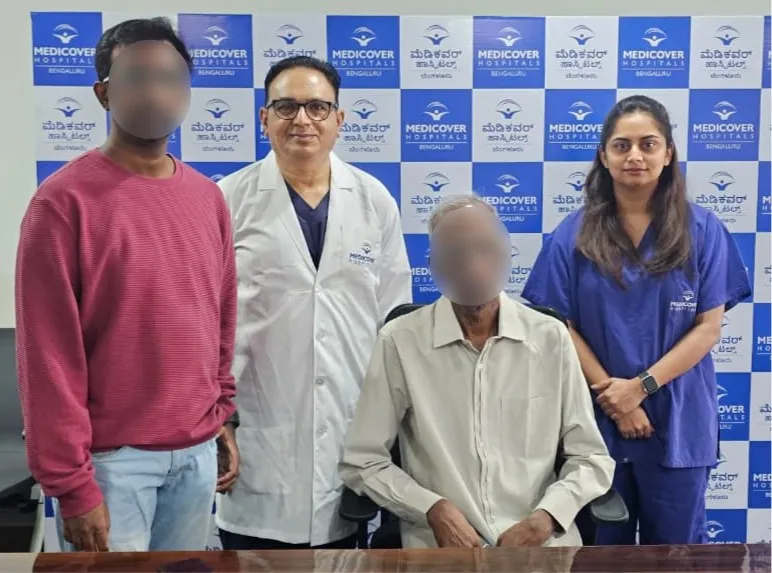
In a major structural heart intervention of its kind, our doctors at Medicover Hospitals, Whitefield, Bengaluru, successfully treated a patient suffering from critical calcific aortic stenosis using Transcatheter Aortic Valve Implantation (TAVI). A pacemaker was then implanted in time to manage the rhythm complication after the procedure.
Emergency Presentation and Critical Diagnosis
The patient suddenly developed severe shortness of breath. This is often a symptom of advanced heart failure. Detailed clinical evaluation and echocardiography confirmed severe calcific aortic stenosis with a functional bicuspid valve. This is a high-risk structural heart condition characterized by critical narrowing of the aortic valve.
Further investigations, including coronary angiography, showed normal coronary arteries, confirming that these symptoms were primarily due to coronary artery disease and not coronary artery disease.
Given the severity of the valve stenosis and associated cardiac compromise, the patient was advised to undergo transcatheter aortic valve implantation (TAVI) as soon as possible.
Advanced Structural Heart Intervention
The TAVI procedure was performed under general anesthesia by Dr. Naga Srinivaas, Director of the Department of Cardiology.
The procedure involved:
- Percutaneous access (minimally invasive approach)
- Predilatation of the native calcified valve
- Implantation of a 29 Evolut Pro valve
- Real-time imaging and hemodynamic monitoring
The valve was successfully deployed, restoring effective blood flow across the aortic valve and significantly improving cardiac function.
Managing a Known High-Risk Complication
After the procedure, the patient had a complete heart attack, a problem that has been noted in some high-risk TAVI cases, especially in patients with severe calcification and bicuspid valve anatomy.
Our cardiac team responded immediately. A dual-chamber permanent pacemaker was implanted the next day to stabilize the heart rhythm and ensure long-term electrical conduction support. The pacemaker implantation was successful, and the patient's heart rhythm normalized.
Recovery and Rehabilitation
Post-procedure care included:
- Careful extubation
- Continuous rhythm monitoring
- Hemodynamic stabilization
- Cardiac rehabilitation
- Gradual mobilization
The patient recovered steadily and is currently stable with satisfactory cardiac function.
Expert Perspective
Speaking about the case, Dr. Naga Srinivaas stated:
"Severe aortic stenosis is fatal if not treated promptly. TAVI has emerged as a highly effective, minimally invasive alternative to open-heart surgery, especially in high-risk patients. Timely intervention, vigilant monitoring, and preparedness to manage complications such as heart block are essential for optimal outcomes. Early diagnosis and appropriate treatment can significantly improve survival and quality of life."
Advancing Structural Heart Care in Bengaluru
This case highlights:
- The importance of early evaluation of breathlessness
- The role of minimally invasive structural heart therapies
- The value of multidisciplinary cardiac coordination
- The ability to manage high-risk complications effectively
Medicover Hospitals, Whitefield continues to strengthen its structural heart program by offering advanced interventions such as:
- Transcatheter Aortic Valve Implantation (TAVI)
- Pacemaker implantation
- Complex coronary interventions
- Comprehensive cardiac rehabilitation
Through expertise, infrastructure, and coordinated cardiac care, the hospital remains committed to delivering advanced heart treatments for high-risk patients.
Contributors

Frequently Asked Questions
For high-risk patients, elderly patients, or those with severe calcification, TAVI is generally considered safer because it avoids the trauma of opening the chest and stopping the heart.
The new replacement valve sits very close to the heart's electrical system. The pressure from the new valve expanding against old, hardened calcium can pinch these electrical pathways, causing the heart rate to drop (heart block). A pacemaker permanently resolves this by sending safe electrical impulses to keep the heart beating at a normal rate.
A normal aortic valve has three leaflets (flaps) that open and close. A bicuspid valve is a congenital defect where the valve only has two leaflets. These valves tend to calcify and narrow much earlier in life and present unique challenges during a TAVI procedure.
Current clinical data suggest that transcatheter aortic valves are highly durable, often lasting 10 to 15 years or more, similar to surgically implanted biological valves.
Read this page in:


