 Call
Call Patient Reports
- Cardiology 84
- Dermatology 45
- Endocrinology 33
- ENT 16
- Fertility 190
- Gastroenterology 78
- General-Medicine 81
- Gynecology 80
- Hematology 19
- Infectious-Diseases 33
- Neurology 52
- Oncology 34
- Ophthalmology 23
- Orthopedics 69
- Pediatrics 31
- Procedure 23
- Public-Health 144
- Pulmonology 59
- Radiology 8
- Urology 68
- Wellness 161
- Woman-and-child 77
- 1758
- 3.7 Minute
Written by Medicover Team and Medically Reviewed by Dr Ravindra Puttaswamaiah Senior Consultant Orthopaedic Surgeon, Bangalore
Debunking the Scoliosis Myths by Orthopaedic Surgeons in Bangalore
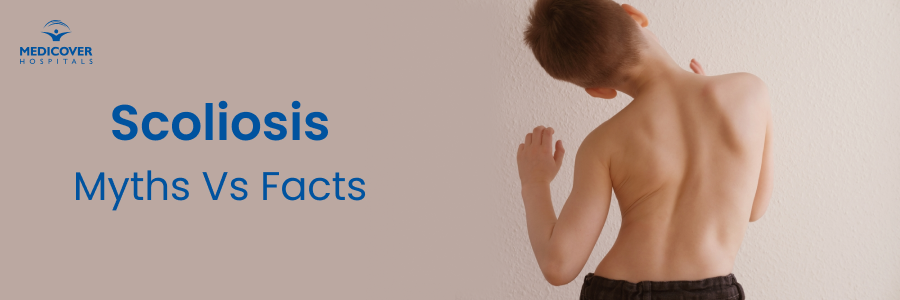
Scoliosis is a condition where the spine curves sideways instead of staying straight. This curve can be mild or more noticeable, and it often forms an "S" or "C" shape when viewed from the back.
Scoliosis is a sideways curvature of the spine. Many beliefs about scoliosis come from outdated ideas or half-understood stories. This can cause unnecessary anxiety for individuals and families.
Clear, accurate information can help you decide when you need care and what to expect. Below are common scoliosis myths and straightforward facts based on standard medical guidance. If you live in Bengaluru, use this to help you find local care, from screening to specialist consultations with the scoliosis surgeon in Bangalore.
Common Scoliosis Misconceptions
Myth 1 - "Only children get scoliosis"
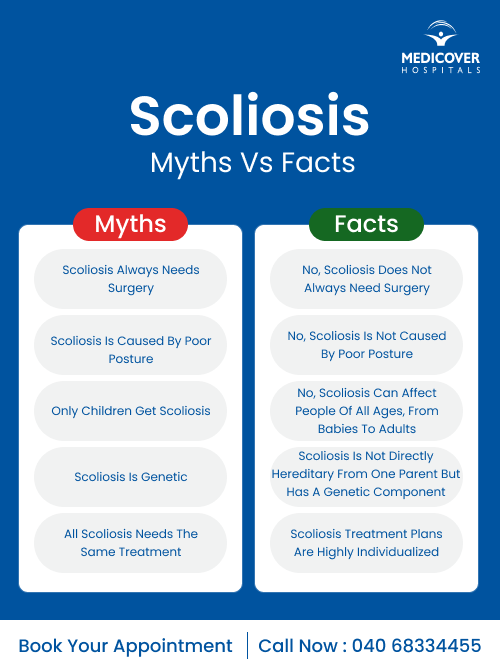
Fact: Scoliosis is commonly diagnosed in children. However, scoliosis can also develop in adults due to the progression of untreated curves or due to the degeneration of spinal discs and joints with age. Screening during the growing years can help in early detection, but adult scoliosis is real and treatable. For local care, many patients seek out the best hospital in Bangalore or experienced spine surgeons when they experience symptoms in adults.
Get a second opinion from trusted experts and makeconfident, informed decisions.
Get Second OpinionNot sure where to start?
Talk to a patient care advisor — free, confidential, 24/7. We'll match you to the right specialist and book your appointment in minutes.
Myth 2 - "Scoliosis always needs surgery"
Fact: Most scoliosis curves do not always require surgery. Management of scoliosis depends on the size of the curve, risk of progression, symptoms, and age. Observation, physiotherapy (including scoliosis-specific exercises), and bracing can control or slow the progression of the curve in many young patients.
Myth 3 - "Wearing a brace will stunt growth or weaken the back permanently"
Fact: Modern braces are designed to support the spine and slow the progression of scoliosis during growth, not to stunt development. Bracing is a prescribed medical treatment used for certain curvature sizes and growth stages.
Bracing can help avoid surgery in most cases when it is properly fitted. Physiotherapy and guided activity maintain muscle strength during bracing; braces are not a substitute for active rehabilitation.
Myth 4 - "Scoliosis is caused by poor posture"
Fact: Structural scoliosis does not occur due to general poor posture. In most adolescents, idiopathic scoliosis does not have a single cause and may be multifactorial (genetic and developmental). Postural changes can make the curve more noticeable, but they are not the root cause. Good posture and core strengthening can help with symptoms and function, but they do not "prevent" idiopathic scoliosis in predisposed children.
Myth 5 - "Scoliosis always causes severe pain"
Fact: Most people with scoliosis have little or no pain, especially when the curves are small. Pain is more common in adults with degenerative changes or large, progressive curves. The level of pain does not always correspond to the degree of the curve.
Myth 6 - "X-rays are dangerous and should be avoided"
Fact: X-rays are essential for the diagnosis and monitoring of scoliosis. Modern radiography uses low doses and doctors apply best practices to minimize exposure, especially in children. The benefits of accurate imaging for treatment decisions usually outweigh the small radiation risk.
Myth 7 - "Physical therapy alone can correct structural scoliosis."
Fact: Exercises alone "rarely correct" spinal curvature. Scoliosis-specific physiotherapy can improve posture, muscle balance, and symptoms, and in some cases help control progression. They are a valuable part of conventional care and are often used with bracing for growing children.
Myth 8 - "Scoliosis is genetic"
Fact: Family history increases the risk, but scoliosis is not necessarily inherited in the usual way. A child of parents with scoliosis is more likely to develop the condition than the general population, but that is not certain. It is advisable to have regular screening during periods of rapid growth when there is a family history, so that intervention can be initiated early if necessary.
Myth 9 - "Scoliosis prevents you from being active or playing sports"
Fact: Most people with scoliosis can participate in normal activities and sports. Activity recommendations depend on the severity and symptoms of the curve. Exercise is often encouraged to maintain strength and flexibility. Only in certain high-risk or symptomatic conditions are certain sports temporarily restricted. Many athletes with scoliosis, such as Usain Bolt, continue to compete in sports with supervision and customized care.
Myth 10 - "All Scoliosis needs the same treatment"
Fact: Scoliosis treatment depends on factors such as age, degree of curvature, curve pattern, risk of progression, symptoms, and overall health. Scoliosis is a spectrum. A customized plan can range from observation to exercises, bracing, injections for pain relief, or surgery in select cases.
Myth 11 - "Scoliosis surgery makes the spine rigid and you will lose all flexibility"
Fact: This is just a misconception about spine surgery. Modern spine surgery aims to correct the deformity while preserving as much function as possible. Fusion procedures reduce motion in the operated segments but often reduce pain and improve overall posture, which increases functional ability. Techniques such as selective fusion, motion-preserving implants, and minimally invasive procedures are used when appropriate to balance correction and mobility.
Myth 12 - "Scoliosis always causes respiratory problems"
Fact: Severe thoracic curves can affect lung function, but mild to moderate curves rarely cause significant breathing problems. Respiratory effects are more relevant for large curves in the thoracic region or when the chest cavity is affected during growth. Most people with scoliosis have normal breathing and activity tolerance.
Your health is everything - prioritize your well-being today.
Schedule Your Appointment
Frequently Asked Questions
Look for uneven shoulders, one shoulder blade more prominent, one hip higher, or the body leaning to one side. If these appear, seek assessment from a spine hospital.
Most scoliosis diagnoses occur during adolescence (ages 10-16) because rapid growth can reveal curvature. Adult-onset scoliosis can appear later due to degeneration.
Initial screening uses physical exam maneuvers (Adam’s forward bend test) and scoliometer measurements. X-rays confirm and measure the curve precisely. Imaging decisions are balanced against the need to track progression.
Bracing is typically recommended for growing children with moderate curves at risk of progression. It aims to stop or slow the curve increase and often helps avoid surgery.
Look for multidisciplinary spine centers with experienced spine surgeons, physiotherapists, and appropriate imaging facilities. Patient outcomes, peer reviews, and availability of scoliosis-specific care teams.
Spine surgeons, orthopaedic surgeons (for children), and rehabilitation specialists manage scoliosis. For complex cases, a multidisciplinary team works best.
Family history increases risk but does not guarantee a child will develop scoliosis. Screening is recommended for children with affected parents.
Yes. Adults may benefit from physiotherapy, pain management, injections, and lifestyle adjustments. Surgery is considered for severe pain, instability, or neurological symptoms.
No. Having a parent with scoliosis does not guarantee that a child will develop it. Genetics can play a role, but scoliosis doesn’t follow a simple inheritance pattern like some other conditions. Many children with scoliosis have no family history at all, and many children of parents with scoliosis never develop it.
On average, scoliosis surgery in Bengaluru may range from Rs. 3,00,000 to Rs. 10,00,000 or more. The cost of scoliosis surgery in Bengaluru varies widely depending on the type of curvature, surgical technique, implant requirements, hospital facilities, and overall medical care needs.
Scoliosis affects children, adolescents, and adults in India, similar to global trends. Research shows that 2-3% of the general population may have some form of scoliosis. In India, adolescent idiopathic scoliosis is the most common type, and early screening helps in preventing progression.
- Cardiology
- Case Studies
- Dermatology
- Endocrinology
- ENT
- Fertility
- Gastroenterology
- General
- General-Medicine
- Gynecology
- Hematology
- Infectious-Diseases
- Medical News
- Neurology
- Oncology
- Ophthalmology
- Orthopedics
- Pediatrics
- Procedure
- Public-Health
- Pulmonology
- Radiology
- Second Opinion
- Urology
- Wellness
- Woman-and-child
Related Blogs
Still have questions? Speak with our experts now!
040-68334455


