 Call
Call Patient Reports
- Cardiology 84
- Dermatology 45
- Endocrinology 33
- ENT 16
- Fertility 190
- Gastroenterology 78
- General-Medicine 81
- Gynecology 80
- Hematology 19
- Infectious-Diseases 33
- Neurology 52
- Oncology 34
- Ophthalmology 23
- Orthopedics 69
- Pediatrics 31
- Procedure 23
- Public-Health 144
- Pulmonology 59
- Radiology 8
- Urology 68
- Wellness 161
- Woman-and-child 77

- 1058
- 6.7 Minute
Written by Medicover Team and Medically Reviewed by Dr Ganesh Krishna Murthy, Senior Consultant Neurosurgeon
Spine Surgery Myths: Clear Facts You Should Know
Spine problems create fear for many people, especially when surgery is recommended. Spine Surgery myths and half-truths make decisions harder and increase anxiety for people who actually need care.
Busting these common Spine Surgery myths is important because the spine is one of the most sensitive and
important parts of the human body.
Here are some of the most common misconceptions people believe
about spine surgery, explained in a simple and reassuring way.
These clarifications are commonly
explained by experienced neurosurgeons in Bengaluru
who manage a large number of spine-related cases.
What are Some Common Myths about Spine Surgery?
Myth 1: “Spine Surgery Requires Complete Bed Rest for Months”
Fact:
Prolonged bed rest is rarely necessary. In fact, staying in bed for a
long time can slow down healing. Gentle movements, physiotherapy,
and specific exercises can help the spine heal better and faster.
Many people imagine that life is
completely restricted after spine surgery. Fearing that they will be confined to bed for many months. This
creates unnecessary fear and delays treatment. The truth is very different.
Modern spine
surgery is much more advanced than it used to be. Most procedures today focus on smaller
incisions, less tissue damage, and faster healing. Depending on the specific condition and type of
surgery, most patients are encouraged to sit, walk, and move around under guidance within a
day or two (of course,recovery is different for each person). These modern recovery
protocols are widely followed in leading hospitals in Bengaluru.
Get a second opinion from trusted experts and makeconfident, informed decisions.
Get Second OpinionNot sure where to start?
Talk to a patient care advisor — free, confidential, 24/7. We'll match you to the right specialist and book your appointment in minutes.
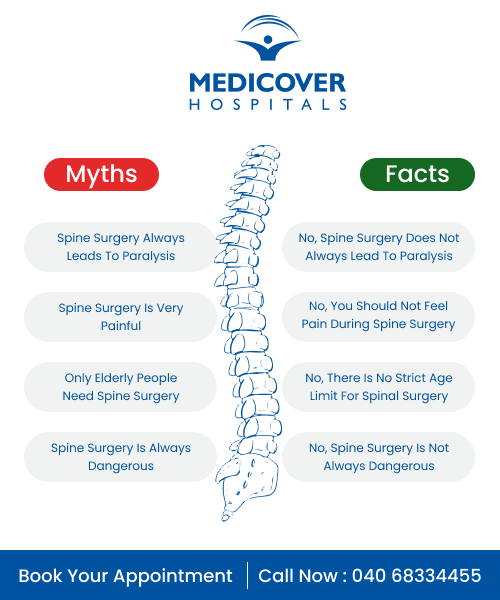
Myth 2: “Spine Surgery Always Leads to Paralysis”
Fact:
Paralysis after spine surgery is rare, especially when done for common conditions such as slipped discs, nerve compression, spinal stenosis, or cervical problems. In fact, modern spine surgery is performed with high-precision instruments, navigation systems, microscopes, and intraoperative monitoring that help protect nerves throughout the procedure.
This is one of the biggest fears in society. Many people believe that touching the spine or nerves automatically increases the risk of paralysis. This myth is often due to outdated stories and a lack of understanding of medical advances.
Myth 3: “Spine Surgery is Very Painful”
Fact:
Pain is a natural concern, especially when people imagine having a spine operation. In the past, recovery was really challenging because older surgical techniques caused tissue disruption. But today’s advanced spine procedures use minimally invasive techniques that significantly reduce post-operative discomfort. Smaller incisions, specialized equipment, and careful tissue handling make recovery smoother and more comfortable. Post-operative pain control has also improved with modern medications and protocols.
Myth 4: “Spine Surgery Involves Using Screws and Rods, Which are Dangerous”
Fact:
Modern implants are made of medical-grade materials that are
designed to be safe inside the body without causing harm. These implants do not restrict movement and, in
most cases, do not trigger alarms at airports or metal detectors. They are very stable and
are placed with careful precision.
Hearing about screws and rods in the spine can be scary. Many people
believe that these implants will make the spine stiff or unsafe. But implants are only used when the
spine needs stability, correction, or support after a disc removal or deformity
correction.
Myth 5: “Once You Have Spine Surgery, You will need Another Surgery”
Fact:
Repeat surgery is only necessary if there is a new injury, age-related
wear and tear, lifestyle factors, or a new problem in a different part of the
spine. Maintaining good posture, regular physiotherapy, appropriate exercise, and a healthy body
weight can greatly reduce the chance of future spine problems.
It is a common fear that you will have
to have more surgeries after a spine surgery. This belief creates hesitation and emotional stress for many
patients. However, surgery is usually recommended to correct a specific problem, such as a herniated disc or spinal canal
narrowing, and once corrected, most people can go on with their lives without the need for additional
operations.
Myth 6: “After Spine Surgery, I will Never get Back to Normal Work or Sports”
Fact:
Most people return to normal work, exercise, and even sports after spine surgery. Modern spine procedures focus on relieving nerve compression, stabilizing the spine, and improving mobility.
Today, Many surgeries are minimally invasive, meaning smaller cuts, less muscle damage, and faster healing. Recovery depends on the specific procedure performed, the severity of the condition, and overall health.
Myth 7: “If I have Spinal Fusion, All My Back Pain will Disappear”
Fact:
Spinal fusion can reduce or eliminate pain caused by specific
structural problems, but it does not guarantee the removal of all back pain.
Fusion
is performed to stabilize an unstable segment, correct deformity, or treat severe degeneration. It targets a
clearly identified pain source, not every possible cause of back discomfort.
Myth 8: “Spine Surgeons Push Surgery They Want to Operate on Everyone”
Fact:
Surgery is suggested only when the structure causing pain or weakness cannot be corrected through
non-operative methods or when the spinal condition creates a risk of nerve damage or
long-term disability.
Most spine-related issues improve with rest, physiotherapy, posture
correction, medications, or targeted injections. Surgery is usually the last
step after conservative care is exhausted.
Spine surgeons follow clear clinical guidelines. Imaging findings are correlated with symptoms to confirm the exact source of the problem, and only then do they decide if the problem can be resolved without surgery.
Your health is everything - prioritize your well-being today.
Schedule Your AppointmentMyth 9: “Only Elderly People Need Spine Surgery”
Fact:
Spine surgery is not limited to older adults or people doing physically demanding jobs. Spine problems can affect individuals of any age. Conditions like disc herniation, nerve compression, congenital abnormalities, trauma, and spinal tumors occur in younger adults as well. When nerve pressure becomes severe or function is at risk, surgery may be needed regardless of age.
Bengaluru sees a high number of young working professionals seeking spine consultations due to long sitting hours and IT-related posture problems. Younger individuals may require surgery because of sudden disc prolapse, sports injuries, or persistent leg pain (sciatica) that does not respond to conservative treatments. Active lifestyles, long sitting hours, poor posture, and repetitive strain can also lead to spinal issues in working professionals.
Myth 10: “Spine Surgery is Always Dangerous”
Fact:
Modern spine surgery is considered safe when performed with proper evaluation, planning, and technology. Risks exist with any surgery, but advancements in imaging, monitoring, minimally invasive techniques, and anesthesia have significantly lowered complication rates.
Minimally invasive spine surgery reduces muscle damage, blood loss, and recovery time. Special instruments and small incisions allow precise work around nerves and bones. Real-time navigation, operating microscopes, and neuromonitoring improve accuracy and help protect the spinal cord and nerves during the procedure.

Frequently Asked Questions
No. Most back and neck problems improve with non-surgical care such as physiotherapy, medications, posture correction, and targeted exercises. Surgery is considered only when symptoms do not respond to these treatments or when there is nerve compression causing weakness, numbness, or difficulty walking.
No. Many modern spine procedures are minimally invasive and may require only a short hospital stay, usually 1-3 days, depending on the procedure and overall health. Recovery is often faster when compared to traditional open surgeries.
Most patients reduce their pain medicines within a short period after surgery. Painkiller dependence is uncommon when medications are used under proper medical guidance and tapered gradually as healing improves.
No. Implants are designed to stabilize the spine so healing can occur safely. They do not restrict normal daily movement once recovery is complete. Many people return to active lifestyles without feeling the presence of implants.
Chronic conditions like diabetes or high blood pressure can be managed safely before and after surgery. With proper pre-operative evaluation and control of medical conditions, most patients can undergo spine surgery with acceptable risk.
No. Surgery aims to strengthen stability by removing pressure from nerves or stabilizing affected segments. When combined with rehabilitation, the spine often becomes more stable and functional than before.
No. Prolonged bed rest is no longer recommended. Early mobilization is encouraged under medical supervision to improve healing, reduce complications, and restore movement faster.
Paralysis from spine surgery is extremely rare. Modern techniques, advanced imaging, real-time nerve monitoring, and microsurgical tools significantly reduce this risk.
No. Most slipped disc cases improve with rest, physiotherapy, medications, and lifestyle changes. Surgery is considered only when symptoms persist or there is significant nerve compression.
Not necessarily. A laser is just one tool and is not suitable for all spine problems. The best technique depends on the diagnosis, severity, anatomy, and safety requirements.
- Cardiology
- Case Studies
- Dermatology
- Endocrinology
- ENT
- Fertility
- Gastroenterology
- General
- General-Medicine
- Gynecology
- Hematology
- Infectious-Diseases
- Medical News
- Neurology
- Oncology
- Ophthalmology
- Orthopedics
- Pediatrics
- Procedure
- Public-Health
- Pulmonology
- Radiology
- Second Opinion
- Urology
- Wellness
- Woman-and-child
Related Blogs
Still have questions? Speak with our experts now!
040-68334455


