 Call
Call Patient Reports
| Focus Area | Recommended Foods | Foods to Avoid After Coronary Bypass Surgery |
|---|---|---|
| Proteins | Plant-based proteins, nuts, and lean poultry. | Red meat, processed meats (sausages), and deep-fried proteins. |
| Fats & Oils | Use minimal amounts of healthy oils. | Trans fats, butter, heavy creams, and reused cooking oils. |
| Carbohydrates | Eat more fresh fruits, vegetables, and whole grains. | Refined sugars, maida (white flour), and sugary baked goods. |
| Sodium (Salt) | Fresh foods flavored with natural herbs. | High-salt items like pickles, papads, canned soups, and salty snacks. |
Find Doctors
Categories
- Cardiology 84
- Dermatology 45
- Endocrinology 33
- ENT 16
- Fertility 190
- Gastroenterology 78
- General-Medicine 81
- Gynecology 80
- Hematology 19
- Infectious-Diseases 33
- Neurology 52
- Oncology 34
- Ophthalmology 23
- Orthopedics 69
- Pediatrics 31
- Procedure 23
- Public-Health 144
- Pulmonology 59
- Radiology 8
- Urology 68
- Wellness 161
- Woman-and-child 77
- 814
- 6.9 Minute
Written by Medicover Team and Medically Reviewed by Dr. Pramod Kumar Kuchulakanti, Chief of Cardiology, Director Structural Heart & Advanced Coronary Interventions
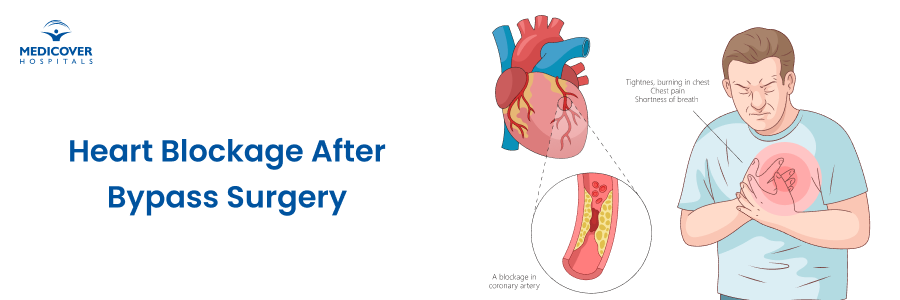
Heart Blockage After Bypass Surgery: Risks, Realities, and Long-Term Prevention
A common and dangerous misconception among people with heart disease is that undergoing coronary artery bypass graft (CABG) permanently cures heart disease. However, medical facts tell a different story.
Key Takeaways
- Bypass surgery is not a permanent solution to heart disease.
- One in three bypass patients may develop new heart blockages over time.
- The chances of having a heart attack after bypass surgery increase if BP, diabetes, and cholesterol are not under control.
- Patients require an annual cardiac evaluation (ECG, Echo, TMT) and are advised to have an angiogram every 5 years to check graft health.
- Regular follow-ups are mandatory after bypass surgery.
- Diet plays a key role in preventing heart bypass surgery recurrence.
- Foods to avoid after coronary bypass surgery include fried foods, high-sal,t and high-fat foods.
- Stopping prescribed blood thinners without consulting a doctor significantly increases the risk of new clots in the stents or grafts.
- If a graft blocks, advanced technologies like IVUS (Intravascular Ultrasound) allow doctors to place stents directly into the old graft, often avoiding a second open-heart surgery.
- Chest pain after bypass surgery should never be ignored.
Get a second opinion from trusted experts and makeconfident, informed decisions.
Get Second OpinionNot sure where to start?
Talk to a patient care advisor — free, confidential, 24/7. We'll match you to the right specialist and book your appointment in minutes.
Can Heart Blockages Return After Bypass?
Yes. Heart block after bypass surgery is a common and serious occurrence. Bypass surgery (CABG) creates a bypass around the blocked arteries, but it does not cure the underlying disease (atherosclerosis).
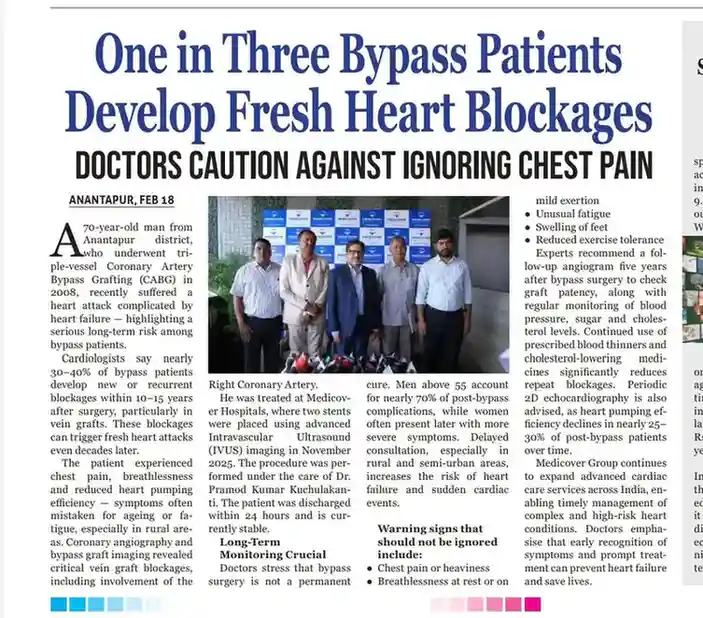
According to leading heart experts at Medicover Hospitals, one in three bypass patients develops fresh heart blockages over time.
"Bypass surgery is not a permanent solution; it is only a stage of treatment," explains Dr. Pramod Kumar Kuchulakanti, Chief of Cardiology, Director Structural Heart & Advanced Coronary Interventions at Medicover Hospitals.
"Docs warn that there is a risk of heart attacks years after bypass surgery because the underlying condition, atherosclerosis or plaque buildup, does not go away as easily. If the patient does not aggressively manage their lifestyle, blood pressure, and cholesterol, the chances of having new heart attacks are high."
To help you understand the realities of heart attack after bypass surgery, Medicover Hospitals experts have compiled this comprehensive clinical guide based on decades of advanced coronary interventions.
The Clinical Proof: A 17-Year Post-Bypass Emergency
To illustrate the long-term risks after bypass surgery, consider a recent complex case successfully treated by Dr. Pramod Kumar Kuchulakanti and his team.
A 70-year-old man from Anantapur district, who had successfully undergone triple vessel bypass surgery in 2008, presented to the Medicover emergency room with severe chest pain and difficulty breathing. As 17 years had passed, the patient felt that his bypass had permanently saved him from heart problems.
An angiogram revealed severe, fresh blockages inside the previously implanted surgical grafts.
Using state-of-the-art IVUS (intravascular ultrasound) technology, Dr. Pramod Kumar Kuchulakanti navigated the complex anatomy of the old, degenerated grafts and successfully placed two new stents. The patient was stabilized, treated, and is currently recovering in good condition.
This case highlights why Medicover Hospitals' advanced cath lab facilities and experienced cardiologists insist that bypass is not the end of heart care, but simply a "new beginning."
What Is Heart Blockage After Bypass Surgery?
Heart blockage after bypass surgery refers to the development of new plaque or blood clots inside surgical grafts (veins or arteries used to bypass the original blockage) or in the heart's original native arteries.
When a surgeon performs a coronary artery bypass graft (CABG), they create a new "bypass" for blood to flow around the blocked artery. However, this surgery does not cure the underlying condition that caused the plaque in the first place. This is called atherosclerosis. As the disease progresses, fatty deposits, cholesterol, and calcium build up inside these newly attached grafts, eventually restricting blood flow to the heart muscle once again.
Why Does Heart Blockage Occur After Bypass Surgery?
Blockages return after surgery because the underlying causes of coronary artery disease are not properly managed. The new grafts are exposed to the same unhealthy blood conditions that destroyed the original arteries.
The primary reasons for recurrent blockages include:
- Progressive atherosclerosis: High levels of LDL (bad cholesterol) and uncontrolled blood sugar continue to deposit sticky plaque inside new grafts.
- Graft deterioration: Veins taken from the leg (saphenous veins) are more likely to narrow over time than arteries taken from the chest (internal mammary arteries). Vein grafts often begin to deteriorate after 10 to 15 years.
- Intimal hyperplasia: This is a biological response where the inner lining of the graft vein becomes abnormally thick, adapting to the high pressure of the artery pumping blood, gradually narrowing the passageway.
- Medication non-adherence: Stopping prescribed blood thinners or antiplatelet medications can cause dangerous blood clots to form suddenly inside stents or surgical grafts.
- Lifestyle factors: Continued smoking, a high-sodium/high-fat diet, and physical inactivity accelerate wear and tear on the cardiovascular system.
Chances of Having a Heart Attack After Bypass Surgery
Although bypass surgery significantly reduces immediate cardiac risks, the chances of having a heart attack after bypass surgery are never zero.
According to cardiovascular data and experts at Medicover Hospitals, one in three people will develop a new heart blockage within a decade if they fail to manage their risk factors.
- The First 5 Years: The risk of a heart attack is relatively low if the patient adheres to their medication and diet.
- 10 to 15 Years Post-Surgery: The risk increases significantly as venous grafts naturally begin to age and narrow.
Ultimately, your chances of having another heart attack are directly tied to your lifestyle. Patients who follow a strict diet after heart bypass surgery, maintain a healthy weight, control their diabetes and blood pressure, and have an angiogram every 5 years can often keep their grafts clear for 20 years or more.
Crucial Precautions After Bypass Surgery
To protect surgical grafts and native arteries from re-clotting or developing new plaque, patients must follow strict precautions after bypass surgery:
- The 5-Year Angiogram Rule: It is advisable to undergo an angiogram every 5 years after bypass surgery, as advised by your cardiologist, to assess the grafts' health.
- Annual Cardiac Evaluations: Regular follow-up tests are the only way to keep the heart healthy in the long term. Never neglect yearly ECG, Echo, and TMT tests.
-
Strict Vitals Management:
- Blood Pressure: Maintain levels close to 120/80 mmHg.
- Blood Sugar: Keep HbA1c levels strictly under control.
- Cholesterol: Aggressively reduce bad cholesterol (LDL).
- Medication Adherence: Never stop blood thinners without a doctor’s explicit advice. Stopping medications dramatically increases the risk of re-clotting in the stent or graft.
- Weight Management: Excess weight increases stress on the heart. Walk or engage in light exercise for at least 30 minutes a day.
- Zero Tolerance for Tobacco: Smoking must be stopped completely. Alcohol consumption should be heavily reduced or avoided entirely.
What is the Diet After Heart Bypass Surgery?
A heart-healthy diet is your daily defense against future blockages. Managing your diet after heart bypass surgery requires a permanent shift toward low-oil, low-salt, and low-fat foods.
What to Eat and Avoid?
Your health is everything - prioritize your well-being today.
Schedule Your AppointmentSymptoms Not to Ignore After Bypass Surgery
If you have a history of bypass surgery, do not dismiss the following symptoms as "gas" or "fatigue." Seek immediate care at a cath lab facility if you experience the following:
- Pressure, heaviness, or pain in the center of the chest.
- Pain radiating to the neck, jaw, shoulder, or left arm.
- Unexplained shortness of breath, especially with mild physical activity.
- Sudden, unusual fatigue, or sudden cold sweats.
Conclusion
Heart attack after bypass surgery is not a rare problem - it is a chronic reality of coronary artery disease. Coronary artery bypass grafting (CABG) restores blood flow and reduces symptoms, but it does not eliminate the underlying process of atherosclerosis.
A real-life case treated at Medicover Hospitals under the leadership of Dr. Pramod Kumar Kuchulakanti clearly shows that heart disease can recur even 17 years after surgery. Timely diagnosis, advanced imaging such as IVUS, and prompt stenting prevented a fatal outcome.
Frequently Asked Questions
No. Bypass surgery is a highly effective treatment for restoring blood flow, but it does not cure atherosclerosis (plaque buildup). Without lifestyle changes and medication, new blockages can form in the local arteries and in the new surgical grafts.
This varies by patient, with venous grafts (taken from the leg) generally having a higher risk of narrowing after 10 to 15 years. Arterial grafts (taken from the chest) last longer. Regular checkups are needed to monitor their condition.
Blood thinners prevent blood clots from forming inside newly attached grafts or previously placed stents. Stopping these medications without your doctor’s explicit instructions can greatly increase your risk of a sudden heart attack due to a fresh clot.
The most effective diet focuses on whole grains, fresh vegetables, fruits, and lean plant-based proteins, while strictly avoiding deep-fried foods, red meat, trans fats, and high-sodium items like pickles and canned foods.
Yes. As demonstrated by Medicover Hospitals’ advanced cardiology team, cutting-edge technologies such as intravascular ultrasound (IVUS) allow specialists to safely place stents in blocked bypass grafts, often avoiding the need for a second open-heart surgery.
Categories
- Cardiology
- Case Studies
- Dermatology
- Endocrinology
- ENT
- Fertility
- Gastroenterology
- General
- General-Medicine
- Gynecology
- Hematology
- Infectious-Diseases
- Medical News
- Neurology
- Oncology
- Ophthalmology
- Orthopedics
- Pediatrics
- Procedure
- Public-Health
- Pulmonology
- Radiology
- Second Opinion
- Urology
- Wellness
- Woman-and-child
Related Blogs
Still have questions? Speak with our experts now!
040-68334455
Read this page in:


