 Call
Call Patient Reports
Best Tumor Mega Arthroplasty Surgery Hospital with Advanced Care
Tumor Mega Arthroplasty at Medicover Hospitals involves the open surgical approach for effective treatment of bone tumors. Our team of MS and DNB-qualified orthopaedic surgeons specialise in complex joint surgeries. This procedure typically results in reduced blood loss and a shorter hospital stay.
Expert Surgeons
Yearly Surgeries
Patient Satisfaction
What is Tumor Mega Arthroplasty?
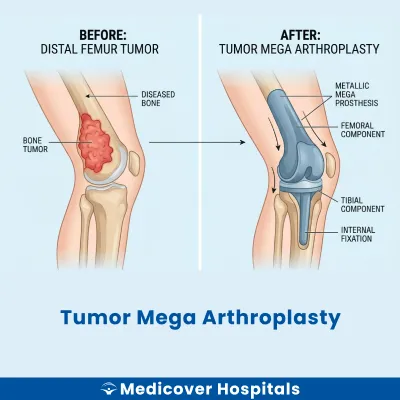
Tumor Mega Arthroplasty is a surgical procedure involving the replacement of a joint with a prosthetic implant. It is often performed on large joints like the hip or knee. This surgery is necessary when a tumour affects the bone or surrounding tissues. The term 'arthroplasty' refers to joint repair or replacement, while 'mega' indicates the extensive nature of the procedure.
This surgery is needed for conditions like bone cancer or aggressive benign tumours. If left untreated, these conditions can lead to severe pain, loss of function, or even fractures. Modern surgical approaches include limb-sparing surgery and custom prosthetic implants. These techniques aim to remove the tumour while preserving as much of the limb's function as possible.
Tumor Mega Arthroplasty Doctors Near You
Discover skilled orthopedics for tumor mega arthroplasty at Medicover Hospitals across India. Choose your city and book a consultation to discuss your treatment options with our experts.
Why Choose Medicover Hospitals for Tumor Mega Arthroplasty?
Get a second opinion from trusted experts and makeconfident, informed decisions.
 Get Second Opinion
Complete Guide To Tumor Mega Arthroplasty
Everything you need to know about the procedure, preparation, and recovery
Tumor Mega Arthroplasty Surgery Indications
Tumor Mega Arthroplasty is recommended when a bone tumor severely affects joint function. It is often considered when other treatments fail to relieve symptoms or halt disease progression.
Severe Joint Pain
Patients experience persistent and intense pain in the joint area, often worsening with movement. Imaging may reveal a large tumor compromising the joint structure. When pain management and other therapies do not provide relief, surgery is considered.
Joint Instability
Patients may notice a feeling of looseness or instability in the joint. Physical examination and imaging can show significant bone destruction or joint misalignment. Surgery becomes necessary when stability cannot be restored through conservative measures.
Functional Impairment
Patients struggle with daily activities due to restricted joint movement. Diagnostic tests may show tumor growth affecting joint mechanics. When physical therapy and medications fail to improve function, surgery is advised.
Pathological Fractures
Patients may suffer fractures with minimal trauma, indicating weakened bone structure. X-rays or MRIs often show a tumor weakening the bone. Surgery is needed when fractures recur or do not heal with standard treatments.
Failed Non-Surgical Treatments
Patients may have undergone chemotherapy or radiation without significant tumor reduction. Scans may show persistent or growing tumors. Surgery is considered when these treatments do not achieve desired results.
How to Prepare for Tumor Mega Arthroplasty?
Preparation is crucial for Tumor Mega Arthroplasty to ensure a smooth surgery and recovery. Proper steps help minimize risks and enhance outcomes.
- Medication Management: Stop NSAIDs, anticoagulants, and herbal supplements as advised by your doctor.
- Fasting Guidelines: Follow a fasting period of 8-12 hours before surgery for general anaesthesia.
- Pre-Surgery Tests: Complete all required blood tests, imaging, and other evaluations as scheduled.
- Clothing: Wear loose, comfortable clothing on the day of surgery for easy dressing post-operation.
- Transportation: Arrange for someone to drive you home after the procedure, as you may not be able to drive.
- Medication List: Bring a list of all medications with dosages to the hospital for reference.
- Pre-Op Instructions: Follow any specific instructions given by your surgeon regarding diet or activities.
- Home Preparation: Set up a comfortable recovery area at home with essentials within easy reach.
Tumor Mega Arthroplasty Surgery (Step-by-Step)
Tumor Mega Arthroplasty is performed by orthopaedic surgeons. The surgery typically lasts 3-5 hours. General anaesthesia is used to ensure the patient is asleep and pain-free during the procedure.
- Preparation: The patient is positioned on the operating table. General anaesthesia is administered. The surgical area is sterilised to prevent infection.
- Incision: A precise incision, usually 10-15 cm, is made over the affected joint. This allows the surgeon to access the tumour and surrounding bone.
- Tumour Removal: The surgeon uses instruments like a curette to carefully remove the tumour. A harmonic scalpel may be used to cut through tissue with minimal bleeding.
- Bone Resection: The affected bone is resected. This involves cutting away the diseased bone while preserving as much healthy tissue as possible.
- Implant Placement: A prosthetic implant is inserted to replace the removed bone. The implant is secured in place, ensuring stability and function.
- Closure: The incision is closed with sutures or staples. A sterile dressing is applied to protect the wound as it heals.
- Recovery: The patient is moved to a recovery room. Monitoring continues as the anaesthesia wears off. Pain management and initial rehabilitation begin.
Who Performs Tumor Mega Arthroplasty Surgery?
Orthopaedic surgeons with expertise in musculoskeletal oncology perform Tumor Mega Arthroplasty. They are trained to manage complex bone and joint conditions, including tumour-related issues. Their skills ensure precise removal of tumours and effective reconstruction of the affected area.
Recovery After Tumor Mega Arthroplasty Surgery
Recovery from Tumor Mega Arthroplasty Surgery involves a gradual process of healing and rehabilitation. Patients can expect a combination of rest, physical therapy, and dietary adjustments to aid recovery.
Day 1-3:
- Hospital stay is common. Pain management and monitoring are priorities.
- Begin with a liquid diet, gradually introducing soft foods like soups and khichdi.
- Minimal movement; assistance needed for basic activities.
Day 4-7:
- Transition to a semi-solid diet including curd, dal-rice, and moong dal.
- Start gentle physiotherapy under guidance to prevent stiffness.
- Continue to rest and avoid putting weight on the affected limb.
Day 8-14:
- Increase in physical activity as tolerated, focusing on range-of-motion exercises.
- Incorporate more solid foods while maintaining a balanced diet.
- Gradual increase in independence for daily activities.
Phase 3 (Week 3-6):
- Regular physiotherapy sessions to strengthen muscles.
- Resume light activities; avoid strenuous tasks.
- Most can return to work or school by the end of this phase, depending on recovery.
When to Seek Urgent Help:
- Severe pain unrelieved by medication.
- Signs of infection: fever, redness, or discharge at the surgical site.
- Sudden swelling or inability to move the limb.
Benefits of Tumor Mega Arthroplasty Surgery
Tumor Mega Arthroplasty is a surgical procedure aimed at replacing bone affected by tumors with a prosthetic implant.
- Pain Relief: Helps alleviate pain caused by bone tumors.
- Improved Mobility: Restores joint function, allowing better movement.
- Enhanced Quality of Life: Enables patients to resume daily activities with ease.
- Prevention of Fractures: Reduces the risk of fractures in weakened bones.
Risks and Complications of Tumor Mega Arthroplasty Surgery
While the surgery can be beneficial, it carries certain risks and potential complications.
- Infection (Common): Risk of infection at the surgical site.
- Prosthetic Loosening (Common): The implant may become loose over time.
- Nerve Damage (Rare): Possible injury to surrounding nerves during surgery.
- Blood Clots (Rare): Formation of clots in the legs or lungs.
- Allergic Reaction (Rare): Reaction to the materials used in the implant.
- Implant Failure (Rare): The prosthetic may fail, requiring revision surgery.
Cost of Tumor Mega Arthroplasty Surgery
The cost of Tumor Mega Arthroplasty Surgery at Medicover Hospitals ranges from Rs. 161,000 to Rs. 660,000, depending on the ward category chosen. The price varies based on the type of accommodation, such as general, twin sharing, private, and deluxe options.
We offer transparent pricing and support for insurance and TPA, including CGHS, ESI, and major TPAs. A cashless facility is also available for your convenience. Please contact the hospital for the latest insurance panel details as these may change periodically.
Frequently Asked Questions
1. How much does Tumor Mega Arthroplasty cost?
The cost for Tumor Mega Arthroplasty surgery at Medicover Hospitals ranges from Rs. 161,000 to Rs. 660,000, depending on the type of room chosen.
2. Is Tumor Mega Arthroplasty covered by insurance?
Tumor Mega Arthroplasty surgery may be covered by CGHS, ESI, and major TPAs with cashless options. Please contact the hospital for current panel details.
3. Will I need a prosthetic after Tumor Mega Arthroplasty?
Yes, a prosthetic joint is typically needed after Tumor Mega Arthroplasty to replace the affected area. This helps restore mobility and function.
4. Can I walk immediately after Tumor Mega Arthroplasty?
Walking may be possible with assistance shortly after surgery. Full mobility usually improves over weeks with physiotherapy and rehabilitation.
5. What are the dietary restrictions post-surgery?
Post-surgery, a balanced diet including soft foods like dal-rice, khichdi, and curd is recommended. Avoid hard or spicy foods initially.
6. Will my joint feel normal after Tumor Mega Arthroplasty?
The joint may feel different initially, but most patients adapt over time. Regular exercises and physiotherapy can help improve joint function.
7. Can Tumor Mega Arthroplasty affect my daily activities?
Initially, daily activities may be limited, but with rehabilitation, most patients return to normal activities. Avoid high-impact activities to protect the joint.
8. What is the difference between megaprosthesis and endoprosthesis?
An endoprosthesis is a general term for any implant placed inside the body to replace a joint or bone. A Megaprosthesis is a specific type of endoprosthesis used to replace large sections of bone, usually after tumor removal.
9. What is a megaprosthesis in the distal femur?
A Megaprosthesis in the distal femur is an implant used to replace the lower part of the thigh bone, commonly after removing bone tumors. It helps preserve the limb and restore walking ability.


