 Call
Call Patient Reports
Advanced Tumor Curettage with Bone Grafting Surgery Hospital with Expert Surgeons
Tumor Curettage with Bone Grafting at Medicover Hospitals involves an open surgical approach. Our orthopaedic team, with qualifications like MS and DNB, performs this procedure to remove bone tumors. This method often results in reduced recovery time and improved bone stability.
Expert Surgeons
Yearly Surgeries
Patient Satisfaction
What is Tumor Curettage With Bone Grafting?
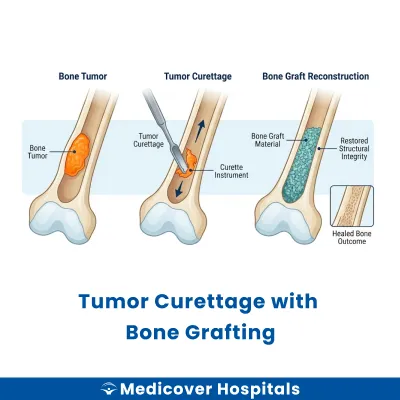
Tumor Curettage with Bone Grafting is a surgical procedure involving the removal of a bone tumor. The affected bone is scraped clean (curettage) to eliminate the tumor cells. After this, the cavity is filled with a bone graft. This graft can be from the patient's own body (autograft) or a donor (allograft). It helps in restoring the bone's structure and function.
This surgery is needed for benign bone tumors, such as giant cell tumors or aneurysmal bone cysts. If untreated, these conditions can weaken the bone, leading to fractures or deformities. Modern surgical approaches include minimally invasive techniques and image-guided surgery. These methods aim to reduce recovery time and improve surgical precision.
Tumor Curettage With Bone Grafting Doctors Near You
Discover orthopedics for tumor curettage with bone grafting at Medicover Hospitals across India. Choose your city and book a consultation to explore treatment options tailored to your needs.
Why Choose Medicover Hospitals for Tumor Curettage With Bone Grafting?
Get a second opinion from trusted experts and makeconfident, informed decisions.
 Get Second Opinion
Complete Guide To Tumor Curettage With Bone Grafting
Everything you need to know about the procedure, preparation, and recovery
Tumor Curettage with Bone Grafting Surgery Indications
Tumor curettage with bone grafting is recommended when a benign bone tumor causes symptoms or structural issues. This procedure helps in removing the tumor and restoring bone integrity.
Benign Bone Tumors
Patients may experience localized pain or swelling in the affected area. Imaging studies like X-rays or MRIs reveal a well-defined lesion. When pain persists despite medication or physical therapy, surgery is considered.
Osteolytic Lesions
These lesions can cause bone weakening, leading to fractures. Patients often report sudden pain or reduced mobility. If imaging shows significant bone loss, surgery is necessary to prevent further damage.
Giant Cell Tumor of Bone
Symptoms include joint pain and swelling, often near the knee or wrist. X-rays may show a lytic area in the bone. When these tumors grow or cause functional impairment, surgical intervention is required.
Unicameral Bone Cysts
Patients might notice a painless swelling or experience a fracture. X-rays reveal a fluid-filled cavity. If the cyst causes recurrent fractures or doesn't heal with conservative measures, surgery is advised.
Aneurysmal Bone Cysts
These cysts often cause pain and swelling. Imaging shows a blood-filled lesion with bone expansion. Surgery is recommended when the cyst enlarges or affects bone stability.
Chondroblastoma
Patients experience joint pain and stiffness. X-rays show a tumor in the epiphysis of long bones. If symptoms persist or worsen, and conservative treatments fail, surgery is needed.
How to Prepare for Tumor Curettage with Bone Grafting?
Proper preparation is crucial for a successful tumor curettage with bone grafting. It ensures safety and enhances recovery. Follow these steps to get ready for your procedure.
- Medication Review: Stop NSAIDs, anticoagulants, and herbal supplements at least a week before surgery.
- Fasting Guidelines: Fast for at least 8 hours before the procedure if general anaesthesia is planned.
- Pre-Surgery Tests: Complete any required blood tests or imaging studies as advised by your doctor.
- Clothing: Wear loose, comfortable clothing on the day of the surgery for ease of movement post-procedure.
- Transportation: Arrange for someone to drive you home after the surgery as you may feel drowsy.
- Medication List: Bring a list of all medications you take, including dosages, to the hospital.
- Smoking and Alcohol: Avoid smoking and alcohol for at least 48 hours before the surgery to aid recovery.
- Hygiene: Bathe with antiseptic soap the night before and the morning of the surgery to reduce infection risk.
Tumor Curettage with Bone Grafting Surgery (Step-by-Step)
This procedure is performed by orthopaedic surgeons. It typically lasts 1 to 3 hours. General anaesthesia is commonly used to ensure the patient is asleep and pain-free.
- Preparation: The patient is positioned on the operating table. The area is sterilised to prevent infection.
- Incision: A small incision, usually 1-2 cm, is made over the site of the tumor.
- Tumor Curettage: A curette, a spoon-shaped instrument, is used to scrape out the tumor tissue from the bone.
- Cleaning the Cavity: The cavity is cleaned using saline solution to remove any remaining tumor cells.
- Bone Grafting: Bone graft material is placed into the cavity. This helps in bone healing and provides structural support.
- Closure: The incision is closed with sutures or staples. A sterile dressing is applied to protect the site.
- Recovery: The patient is moved to a recovery room. Vital signs are monitored as the anaesthesia wears off.
Who Performs Tumor Curettage with Bone Grafting Surgery?
This surgery is performed by orthopaedic surgeons who specialise in bone and joint conditions. They have expertise in removing tumors and reconstructing bones using grafts. Please contact the hospital for current details as insurance panels may change.
Recovery After Tumor Curettage with Bone Grafting Surgery
Recovery from tumor curettage with bone grafting surgery involves a gradual return to normal activities. It is important to follow your doctor's instructions to ensure proper healing.
Day 1-3:
- Rest is crucial. Keep the affected limb elevated to reduce swelling.
- Pain and discomfort are common. Take prescribed medications as directed.
- Begin with a soft diet. Include foods like curd, dal-rice, and soups.
Day 4-7:
- Continue to limit movement. Use crutches or a walker if advised.
- Introduce light exercises as recommended by your physiotherapist.
- Gradually add moong dal and khichdi to your diet for protein and energy.
Week 2-4:
- Swelling and bruising should start to decrease.
- Follow up with your doctor to monitor healing progress.
- Begin to resume light activities. Avoid strenuous tasks.
- Maintain a balanced diet rich in nutrients to support bone healing.
Phase 2 (Month 1-3):
- Gradually increase physical activity as per medical advice.
- Return to work or school may be possible, depending on your recovery.
- Continue physiotherapy sessions to regain full mobility.
When to Seek Urgent Help:
- Severe pain not relieved by medication.
- Excessive swelling or redness around the surgical site.
- Fever or chills indicating possible infection.
- Any unusual discharge from the wound.
Benefits of Tumor Curettage with Bone Grafting Surgery
Tumor curettage with bone grafting is a surgical procedure aimed at removing bone tumors while preserving bone structure.
- Preservation of Bone Integrity: Helps maintain the structural integrity of the bone after tumor removal.
- Reduced Recovery Time: Compared to more invasive procedures, recovery may be quicker.
- Minimally Invasive: Involves less tissue damage, which can lead to less postoperative pain.
- Restoration of Function: Aims to restore normal function and strength to the affected bone.
Risks and Complications of Tumor Curettage with Bone Grafting Surgery
While generally safe, tumor curettage with bone grafting carries certain risks and potential complications.
Common Risks:
- Infection at the surgical site may occur, requiring antibiotics.
- Bleeding during or after surgery is possible.
Rare Complications:
- Graft rejection, where the body does not accept the bone graft.
- Fracture of the bone during or after the procedure.
- Recurrence of the tumor, necessitating further treatment.
- Nerve damage, potentially leading to numbness or weakness.
Cost of Tumor Curettage with Bone Grafting Surgery
The cost of Tumor Curettage with Bone Grafting Surgery across Medicover Hospitals ranges from Rs.16500 to Rs. 25500. The price varies depending on the ward category chosen, from general to deluxe suites. We offer transparent pricing to ensure clarity for our patients.
Insurance and TPA support are available, with acceptance of CGHS, ESI, and major TPAs. A cashless facility is also provided for your convenience. Please contact the hospital for the latest insurance panel details as these may change periodically.
Frequently Asked Questions
1. How much does Tumor Curettage with Bone Grafting surgery cost at Medicover Hospitals?
The cost ranges from Rs. 16500 to Rs. 25500 at Medicover Hospitals, depending on the type of room and care required.
2. Is Tumor Curettage with Bone Grafting surgery covered under health insurance at Medicover?
This surgery may be covered under health insurance, including CGHS, ESI, and major TPAs. Please contact the hospital for current panel details.
3. Will I need a cast after bone grafting?
Yes, a cast or splint is often required to stabilize the area. This helps ensure proper healing after the procedure.
4. Can I walk immediately after bone grafting?
Walking is usually restricted initially to allow healing. Your doctor will advise when it's safe to resume normal activities.
5. What foods help bone healing after grafting?
Consume calcium-rich foods like curd and leafy greens. Protein-rich foods such as dal-rice and khichdi also support bone healing.
6. Will I experience pain after tumor curettage?
Some pain and discomfort are common after the procedure. Pain management will be provided to help you recover comfortably.
7. Can the tumor recur after curettage?
There is a possibility of recurrence, depending on the tumor type. Regular follow-ups with your doctor are essential for monitoring.


