 Call
Call Patient Reports
Single Stage Urethroplasty for Stricture Urethra Surgery
Single stage urethroplasty for stricture urethra at Medicover Hospitals is performed using open surgical techniques by our skilled urologists with qualifications like MS, DNB, and MCh. This approach often results in shorter hospital stays and reduced recovery time for patients.
Expert Surgeons
Yearly Surgeries
Patient Satisfaction
What is Single Stage Urethroplasty for Stricture Urethra?
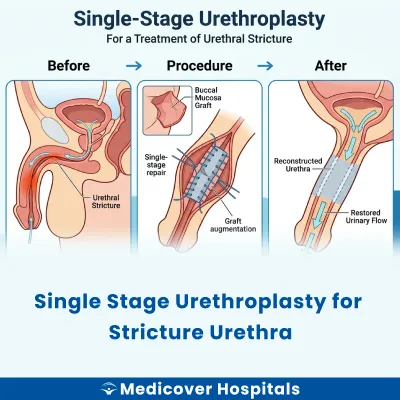
Single stage urethroplasty is a surgical procedure to treat stricture urethra. The urethra is the tube that carries urine from the bladder out of the body. In this procedure, the narrowed section of the urethra is repaired or reconstructed in one operation. This helps restore normal urine flow and function.
This surgery is needed when the urethra becomes narrowed due to scar tissue. Causes include injury, infection, or previous surgeries. If left untreated, it can lead to urinary retention, infections, or kidney damage. Modern surgical approaches for this procedure include buccal mucosa graft (using tissue from inside the mouth) and end-to-end anastomosis (connecting two ends of the urethra). These techniques help achieve effective results.
Single Stage Urethroplasty for Stricture Urethra Doctors Near You
Discover expert urologists for single stage urethroplasty at Medicover Hospitals across India. Choose your city and book a consultation to address stricture urethra effectively.
Why Choose Medicover Hospitals for Single Stage Urethroplasty for Stricture Urethra?
Get a second opinion from trusted experts and makeconfident, informed decisions.
 Get Second Opinion
Complete Guide To Single Stage Urethroplasty For Stricture Urethra
Everything you need to know about the procedure, preparation, and recovery
Single stage urethroplasty for stricture urethra Surgery Indications
Doctors recommend single stage urethroplasty when urethral strictures cause significant symptoms. It is often considered when other treatments do not provide relief or when the stricture is complex.
Severe Urinary Retention
Patients may experience difficulty urinating or a weak urine stream. On examination, the bladder may be distended. Imaging may show a narrowed urethra. When catheterisation or dilation fails, surgery is considered.
Recurrent Urinary Tract Infections (UTIs)
Frequent UTIs can occur due to urine stagnation. Patients often report burning sensation or cloudy urine. Lab tests may show bacterial growth. If antibiotics and other treatments do not help, surgery may be needed.
Post-Void Dribbling
Some patients experience dribbling after urination. This can be due to incomplete bladder emptying. Uroflowmetry may show reduced flow rates. When lifestyle changes and medications do not work, surgery is an option.
Bladder Stones
Patients might have pain or blood in urine. Imaging can reveal stones and a narrowed urethra. If stones recur despite treatment, surgery may be advised to address the underlying stricture.
Severe Stricture on Imaging
Urethrograms or cystoscopy may show a long or complex stricture. Patients might have obstructive symptoms. When non-surgical methods are ineffective, a single stage urethroplasty may be recommended.
How to Prepare for Single stage urethroplasty for stricture urethra?
Proper preparation is crucial for a successful single stage urethroplasty. It helps minimise complications and ensures a smoother recovery process.
- Medication Review: Stop NSAIDs, anticoagulants, and herbal supplements 7 days before surgery. Consult your doctor for guidance.
- Fasting Guidelines: Do not eat or drink anything for at least 8 hours before the procedure to ensure safety during anaesthesia.
- Pre-Surgery Hygiene: Take a shower using antiseptic soap the night before and the morning of the surgery.
- Comfortable Clothing: Wear loose-fitting clothes on the day of the surgery for comfort and ease of movement post-procedure.
- Transportation Arrangement: Plan for someone to drive you home after the surgery as you may feel drowsy from anaesthesia.
- Medication List: Bring a list of all medications you take, including dosages, to inform the medical team.
- Smoking Cessation: Avoid smoking for at least 2 weeks before surgery to promote better healing.
- Pre-Operative Tests: Complete any required blood tests or imaging studies as advised by your healthcare provider.
Single stage urethroplasty for stricture urethra Surgery (Step-by-Step)
This surgery is performed by urologists. It typically lasts 2-4 hours and is done under general anaesthesia.
- Preparation: The patient is positioned and given general anaesthesia. The surgical area is cleaned and sterilised.
- Incision: A small incision, usually 1-2 cm, is made near the affected area to access the urethra.
- Exposure: The urethra is carefully exposed using surgical retractors. This allows the surgeon to clearly see the stricture.
- Excision of Stricture: The narrowed segment of the urethra is removed using a scalpel or surgical scissors. Care is taken to preserve healthy tissue.
- Reconstruction: The urethra is reconstructed. This may involve grafting tissue from another part of the body, such as the buccal mucosa, to widen the urethra.
- Closure: The incision is closed with sutures. A catheter may be placed to ensure proper urine flow during recovery.
- Recovery: The patient is monitored as they wake from anaesthesia. Pain management and instructions for care are provided.
Who Performs Single stage urethroplasty for stricture urethra Surgery?
This surgery is performed by urology doctors who specialise in urinary tract and male reproductive system surgeries. They have expertise in managing urethral strictures and are skilled in reconstructive techniques.
Recovery After Single stage urethroplasty for stricture urethra Surgery
Recovery from a single stage urethroplasty for stricture urethra involves careful monitoring and gradual return to normal activities. Patients can expect some discomfort and need to follow specific guidelines to ensure proper healing.
Day 1-3:
- Rest is crucial. Limit movement and avoid any strenuous activities.
- Maintain a liquid diet initially, gradually introducing soft foods like curd, dal-rice, and soups.
- Pain and swelling are common. Follow prescribed medications for relief.
Day 4-7:
- Begin light activities as tolerated, but avoid heavy lifting or exertion.
- Continue with a soft diet. Include khichdi and moong dal for easy digestion.
- Ensure adequate hydration to aid recovery.
Day 8-14:
- Gradually increase activity levels, but still avoid strenuous exercise.
- Return to normal diet, focusing on balanced meals with fruits and vegetables.
- Most patients can resume work or school towards the end of this period, depending on individual recovery.
Phase 3 (Week 3-4):
- Resume most daily activities, but continue to avoid heavy lifting.
- Consult your doctor before engaging in any physical exercise or sports.
When to Seek Urgent Help:
- Severe pain or swelling that does not improve with medication.
- Fever or chills indicating possible infection.
- Difficulty urinating or blood in urine.
- Any unusual discharge or foul smell from the surgical site.
Benefits of Single stage urethroplasty for stricture urethra Surgery
Single stage urethroplasty is a surgical procedure aimed at resolving urethral strictures in one operation.
- Restoration of Urinary Flow: Helps in restoring normal urine flow by removing the stricture.
- Reduced Need for Future Surgeries: Often eliminates the need for multiple procedures.
- Improved Quality of Life: Alleviates symptoms like pain and frequent urination, enhancing daily life.
- Shorter Recovery Time: Compared to multi-stage procedures, recovery is typically quicker.
Risks and Complications of Single stage urethroplasty for stricture urethra Surgery
While generally effective, single stage urethroplasty carries certain risks and potential complications.
- Common: Infection at the surgical site, which may require antibiotics.
- Common: Bleeding during or after the procedure.
- Rare: Recurrence of the urethral stricture, necessitating further treatment.
- Rare: Urethral fistula, an abnormal connection that may form.
- Rare: Erectile dysfunction, though this is uncommon.
- Rare: Urinary incontinence, which may occur post-surgery.
Cost of Single stage urethroplasty for stricture urethra Surgery
The cost for Single stage urethroplasty for stricture urethra surgery at Medicover Hospitals ranges from Rs. 90,000 to Rs. 1,50,000. The price varies depending on the ward category chosen, such as general, twin sharing, or private rooms.
Medicover Hospitals offers transparent pricing with support for insurance and TPA, including CGHS, ESI, and major TPAs. Cashless facilities are available to ease the financial process. Please contact the hospital for the latest insurance panel details as these may change periodically.
Frequently Asked Questions
1. How much does Single stage urethroplasty for stricture urethra surgery cost at Medicover Hospitals?
The cost for Single stage urethroplasty for stricture urethra surgery ranges from Rs. 90,000 to Rs. 1,50,000 across Medicover Hospitals.
2. Is Single stage urethroplasty for stricture urethra surgery covered under health insurance at Medicover?
Yes, it is generally covered by CGHS, ESI, and major TPAs. Please contact the hospital for current panel details.
3. Will I need a catheter after urethroplasty?
Yes, a catheter is typically required for a few weeks post-surgery. It helps in proper healing of the urethra.
4. Can urethral stricture recur after surgery?
There is a possibility of recurrence, but it is less common. Regular follow-ups can help in early detection and management.
5. What foods should I avoid post-urethroplasty?
Avoid spicy and acidic foods like pickles and citrus fruits. Opt for soft foods like curd, dal-rice, and khichdi for comfort.
6. How soon can I return to work after urethroplasty?
Most patients can return to work within 2-4 weeks. It depends on the nature of your job and your recovery progress.
7. Will I experience pain while urinating after surgery?
Mild discomfort is common initially, but it should subside. Persistent pain should be discussed with your doctor for proper evaluation.


