 Call
Call Patient Reports
Best Hospital for Retrograde Intrarenal Surgery with Advanced Urology Care
Retrograde Intrarenal Surgery (RIRS) at Medicover Hospitals is an advanced endoscopic procedure performed by skilled urologists with qualifications like MS, DNB, and MCh. This minimally invasive technique allows for precise kidney stone removal, resulting in smaller incisions and reduced blood loss.
Expert Surgeons
Yearly Surgeries
Patient Satisfaction
What is Retrograde Intrarenal Surgery?
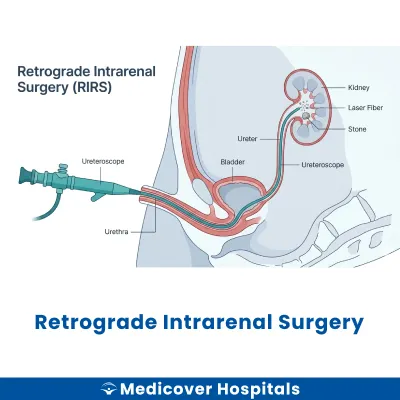
Retrograde Intrarenal Surgery (RIRS) is a minimally invasive procedure used to treat kidney stones. It involves accessing the kidney through the ureter (the tube connecting the kidney to the bladder) using a flexible endoscope. This allows the surgeon to directly view and remove stones or perform laser fragmentation. The procedure is performed under general or spinal anaesthesia, ensuring patient comfort.
RIRS is often necessary for patients with kidney stones that are too large or located in areas difficult to reach with other methods. If left untreated, these stones can cause severe pain, infections, or kidney damage. Modern surgical approaches for RIRS include laser lithotripsy, which uses laser energy to break stones into smaller pieces for easier removal.
Retrograde Intrarenal Surgery Doctors Near You
Find expert urologists for Retrograde Intrarenal Surgery at Medicover Hospitals across India. Choose your city and book a consultation to address your kidney concerns with skilled professionals.
Why Choose Medicover Hospitals for Retrograde Intrarenal Surgery?
Get a second opinion from trusted experts and makeconfident, informed decisions.
 Get Second Opinion
Complete Guide To Retrograde Intrarenal Surgery
Everything you need to know about the procedure, preparation, and recovery
Retrograde Intrarenal Surgery Procedure Indications
Retrograde Intrarenal Surgery (RIRS) is recommended by urologists when less invasive treatments for kidney stones or other renal issues are ineffective. This procedure is often chosen when stones are difficult to reach or when patients experience persistent symptoms despite conservative management.
Recurrent Kidney Stones
Patients may experience severe flank pain, blood in urine, or recurrent urinary tract infections. Imaging tests like CT scans reveal stones that are not passing naturally. When medications and hydration fail to prevent recurrence, RIRS is considered.
Large Kidney Stones
Severe pain and obstruction in urine flow are common symptoms. Ultrasound or CT imaging shows stones larger than 2 cm. If extracorporeal shock wave lithotripsy (ESWL) is ineffective, RIRS is recommended.
Stones in Hard-to-Reach Areas
Patients may have persistent pain and urinary symptoms. Imaging reveals stones in the lower pole of the kidney or in complex anatomical locations. When other methods cannot access these areas, RIRS is advised.
Failed Previous Stone Treatments
Patients experience ongoing symptoms despite previous interventions. Imaging shows residual or new stones post-treatment. RIRS is chosen when other surgical options do not provide relief.
Kidney Stones with Anatomical Abnormalities
Symptoms include pain and recurrent infections. Imaging identifies stones in kidneys with structural anomalies. When standard treatments are ineffective due to these abnormalities, RIRS is considered.
How to Prepare for Retrograde Intrarenal Surgery?
Proper preparation is crucial for Retrograde Intrarenal Surgery to ensure a smooth procedure and recovery. Follow these steps to get ready for your surgery.
- Medication Review: Stop NSAIDs, anticoagulants, and herbal supplements at least a week before surgery.
- Fasting Guidelines: Do not eat or drink anything for at least 6-8 hours before the procedure.
- Hydration: Stay well-hydrated the day before surgery, unless advised otherwise by your doctor.
- Clothing: Wear loose, comfortable clothing on the day of the surgery for easy mobility post-procedure.
- Transportation: Arrange for someone to drive you home after the surgery, as you may feel drowsy from anaesthesia.
- Medication List: Bring a list of all medications you are currently taking, including dosages, to the hospital.
- Pre-Surgery Instructions: Follow any specific instructions given by your healthcare provider, such as bowel prep if advised.
- Rest Well: Ensure you get a good night's sleep before the day of surgery to help your body recover better.
Retrograde Intrarenal Surgery Procedure (Step-by-Step)
Retrograde Intrarenal Surgery (RIRS) is performed by urologists. The procedure typically lasts 1-2 hours and is done under general anaesthesia.
- Preparation: The patient is given general anaesthesia to ensure comfort and relaxation. The surgical area is cleaned and sterilised.
- Ureteroscope Insertion: A flexible ureteroscope is gently inserted through the urethra and bladder into the ureter. The patient remains unconscious and does not feel any discomfort.
- Navigation to Kidney: The ureteroscope is carefully advanced into the kidney. The surgeon uses a camera attached to the ureteroscope to locate the kidney stones.
- Stone Fragmentation: A laser fibre is passed through the ureteroscope. The laser is used to break the stones into smaller fragments. The patient remains unaware of this process due to anaesthesia.
- Stone Removal: A basket-like instrument is used to capture and remove the stone fragments. Alternatively, fragments may be left to pass naturally.
- Stent Placement: A temporary stent may be placed in the ureter to ensure proper drainage and healing. The patient will not feel the stent insertion.
- Completion: The ureteroscope is carefully withdrawn. The patient is moved to a recovery area to awaken from anaesthesia.
Who Performs Retrograde Intrarenal Surgery Procedure?
Retrograde Intrarenal Surgery is performed by urologists. These specialists have expertise in diagnosing and treating conditions of the urinary tract and kidneys. They use advanced instruments to ensure precise and effective treatment.
Recovery After Retrograde Intrarenal Surgery Procedure
Recovery from Retrograde Intrarenal Surgery (RIRS) is generally smooth. Most patients can resume normal activities within a few days. However, it's essential to follow your doctor's advice for a swift recovery.
Day 1-3:
- Rest is crucial. Avoid strenuous activities.
- Hydrate well. Drink plenty of water to help flush out any remaining stone fragments.
- Stick to a light diet. Include foods like curd, dal-rice, and soups.
- You may experience mild discomfort or blood in urine. This is normal but should decrease over time.
Day 4-7:
- Gradually increase activity levels. Short walks are encouraged.
- Continue with a balanced diet. Include moong dal and khichdi for easy digestion.
- Avoid lifting heavy objects or engaging in vigorous exercise.
- Most patients can return to work or school by the end of this week, depending on their comfort level.
Day 8-14:
- Resume normal activities as tolerated. Listen to your body and rest if needed.
- Maintain a healthy diet to support recovery and prevent future stones.
- Regular follow-up with your doctor is essential to monitor healing.
When to Seek Urgent Help:
- Severe pain unrelieved by medication.
- High fever or chills.
- Persistent nausea or vomiting.
- Heavy bleeding or clots in urine.
If you experience any of these symptoms, contact us immediately.
Benefits of Retrograde Intrarenal Surgery procedure
Retrograde Intrarenal Surgery (RIRS) is a minimally invasive procedure used to treat kidney stones and other intrarenal conditions.
- Minimally Invasive: RIRS involves no incisions, reducing recovery time.
- High Precision: Allows for precise targeting of kidney stones.
- Quick Recovery: Patients often experience a faster return to normal activities.
- Reduced Pain: Less postoperative pain compared to traditional surgery.
- Outpatient Procedure: Often performed as a day-care procedure, minimizing hospital stay.
Risks and Complications of Retrograde Intrarenal Surgery procedure
While RIRS is generally safe, it carries some risks and potential complications.
- Urinary tract infections can occur post-procedure.
- Mild bleeding may be experienced during or after the procedure.
- Injury to the ureter or kidney may occur.
- Stone fragments may remain, requiring additional treatment.
- Reaction to anaesthesia can occur, though it is uncommon.
- Stricture formation in the ureter may develop over time.
What is the Cost of Retrograde Intrarenal Surgery Procedure?
The cost of Retrograde Intrarenal Surgery at Medicover Hospitals ranges from Rs. 120,000 to Rs. 390,000. The price varies depending on the ward category chosen, such as outpatient, day care, general, or suite options. We offer transparent pricing to ensure clarity for our patients.
Insurance and TPA support, including CGHS, ESI, and major TPAs, are accepted. A cashless facility is also available for added convenience. Please contact the hospital for the latest insurance panel details as these may change periodically.
Frequently Asked Questions
1. How much does Retrograde Intrarenal Surgery cost?
The cost for Retrograde Intrarenal Surgery at Medicover Hospitals ranges from Rs. 1,20,000 to Rs. 3,90,000, depending on the facility type.
2. Is Retrograde Intrarenal Surgery covered by insurance?
Yes, it is often covered by CGHS, ESI, and major TPAs with cashless options. Please contact the hospital for current panel details.
3. Will I need a stent after Retrograde Intrarenal Surgery?
Yes, a stent is often placed to ensure proper urine flow. It is usually removed in a follow-up visit.
4. Can kidney stones recur after Retrograde Intrarenal Surgery?
Yes, kidney stones can recur if preventive measures are not taken. Regular check-ups and dietary changes are recommended.
5. What foods should I avoid after Retrograde Intrarenal Surgery?
Avoid high-oxalate foods like spinach and nuts. Stick to a diet of curd, dal-rice, and khichdi for a smooth recovery.
6. How soon can I return to work after Retrograde Intrarenal Surgery?
Most patients can return to work within one to two weeks. However, it depends on individual recovery and doctor's advice.
7. Is there a risk of infection after Retrograde Intrarenal Surgery?
Yes, there is a small risk of urinary tract infection. Maintaining hygiene and following doctor's instructions can minimise this risk.


