 Call
Call Patient Reports
Partial Penectomy Surgery Hospital with Advanced Onco-Urology Care
Partial penectomy at Medicover Hospitals is performed using an open surgical approach by our expert urologists with qualifications such as MS, DNB, and MCh. This procedure effectively addresses penile cancer, resulting in shorter hospital stays and reduced recovery times for patients across India.
Expert Surgeons
Yearly Surgeries
Patient Satisfaction
What is Partial Penectomy?
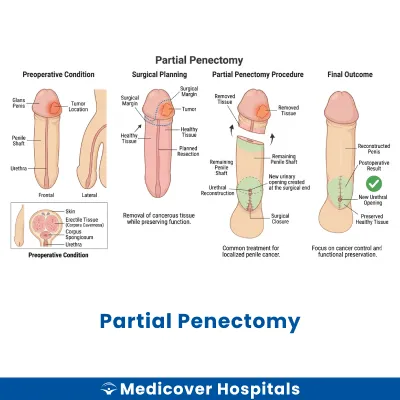
Partial penectomy is a surgical procedure involving the removal of part of the penis. This operation is typically performed to treat penile cancer. The penis is the male reproductive organ, and in this context, the surgery aims to excise cancerous tissues while preserving as much of the organ as possible. The goal is to maintain urinary and sexual function, depending on the extent of the surgery.
This surgery is necessary when cancer affects the penis but has not spread extensively. Conditions like penile cancer can lead to severe complications if untreated, including the spread of cancer to other parts of the body. Modern surgical approaches for partial penectomy include laser surgery and Mohs micrographic surgery, which focus on removing cancerous tissues with precision. Early intervention is crucial for better outcomes.
Partial Penectomy Doctors Near You
Explore skilled urologists for partial penectomy at Medicover Hospitals across India. Select your city and book a consultation to discuss treatment options and receive expert care.
Why Choose Medicover Hospitals for Partial Penectomy?
Get a second opinion from trusted experts and makeconfident, informed decisions.
 Get Second Opinion
Complete Guide To Partial Penectomy
Everything you need to know about the procedure, preparation, and recovery
Partial Penectomy Surgery Indications
Partial penectomy is recommended when less invasive treatments are not effective. It is primarily considered for specific conditions affecting the penis, where preserving as much function as possible is a priority.
Penile Cancer
Patients may experience a persistent sore or lump on the penis. There might be bleeding or unusual discharge. Biopsy results confirm malignancy. When cancer is localized and conservative treatments fail, partial penectomy is advised.
Severe Penile Trauma
Severe trauma can lead to tissue damage and necrosis. Patients may report intense pain and swelling. Imaging may show non-viable tissue. If reconstructive options are insufficient, partial penectomy might be necessary.
Recurrent Infections
Chronic infections can cause pain, swelling, and discharge. Antibiotics may not resolve the issue. Persistent infections with tissue damage seen in lab tests may lead to the need for partial penectomy.
Advanced Lichen Sclerosus
This condition causes white patches and scarring. Patients often have itching and pain. When topical treatments fail and scarring affects function, surgery is considered.
Severe Phimosis
Phimosis can cause pain and difficulty urinating. Examination reveals tight foreskin that cannot retract. When conservative measures like circumcision are not viable, partial penectomy may be needed.
How to Prepare for Partial Penectomy?
Preparation is crucial for a smooth partial penectomy procedure and recovery. Proper steps can help reduce risks and improve outcomes.
- Medication Review: Stop NSAIDs, anticoagulants, and herbal supplements at least 7 days before surgery.
- Fasting Guidelines: Fast for at least 8 hours before the procedure if general anaesthesia is used.
- Pre-Surgical Hygiene: Bathe with antiseptic soap on the day of surgery to reduce infection risk.
- Clothing: Wear loose, comfortable clothing to the hospital for ease post-surgery.
- Transportation: Arrange for someone to drive you home after the procedure.
- Medication List: Bring a list of current medications with dosages for hospital records.
- Smoking and Alcohol: Avoid smoking and alcohol for at least 48 hours before surgery.
- Consent and Questions: Ensure all consent forms are signed and clarify any doubts with your surgeon.
Partial Penectomy Surgery (Step-by-Step)
Partial penectomy is performed by specialists in urological care. The surgery typically lasts 1-2 hours. It is usually done under general anaesthesia to ensure the patient is asleep and pain-free.
- Preparation: The patient is positioned on the operating table. The surgical area is cleaned and sterilised to prevent infection.
- Incision: A 1-2 cm incision is made at the base of the penis. This allows access to the affected area.
- Tumour Removal: The surgeon uses a scalpel or harmonic scalpel to carefully remove the cancerous tissue. A margin of healthy tissue is also removed to ensure all cancer cells are excised.
- Bleeding Control: Bipolar cautery is used to control bleeding. This instrument helps seal blood vessels and minimise blood loss.
- Reconstruction: The remaining part of the penis is reshaped. This helps maintain as much function and appearance as possible.
- Closure: The incision is closed with sutures. A dressing is applied to protect the area and promote healing.
- Recovery: The patient is moved to a recovery room. Vital signs are monitored as the anaesthesia wears off. Pain management is provided as needed.
Who Performs Partial Penectomy Surgery?
Partial penectomy is performed by urologists. These specialists have expertise in the urinary tract and male reproductive organs. They are trained to handle complex procedures involving the penis and surrounding tissues.
Recovery After Partial Penectomy Surgery
Recovery after a partial penectomy involves physical healing and adapting to changes. It's essential to follow medical advice for a smooth recovery process. Expect some discomfort initially, but it should gradually improve.
Day 1-3:
- Rest is crucial. Avoid any strenuous activities.
- Manage pain with prescribed medications.
- Keep the surgical area clean and dry.
Day 4-7:
- Continue with light activities. Avoid heavy lifting.
- Introduce soft, easily digestible foods like curd, dal-rice, and khichdi.
- Monitor for any signs of infection at the surgical site.
Day 8-14:
- Gradually increase physical activity as tolerated.
- Return to work or school if your job is not physically demanding.
- Include nutritious foods like moong dal and soups to aid healing.
Phase 3-6 Weeks:
- Resume normal activities, but listen to your body.
- Continue with a balanced diet to support recovery.
- Follow up with your doctor for any concerns.
When to Seek Urgent Help
- Severe pain not relieved by medication.
- Excessive bleeding or discharge from the surgical site.
- High fever or signs of infection like redness and swelling.
- Difficulty urinating or any unusual symptoms.
If you experience any of these symptoms, contact your healthcare provider immediately.
Benefits of Partial Penectomy Surgery
Partial penectomy is a surgical procedure aimed at removing cancerous tissues while preserving as much of the penis as possible.
- Preservation of Function: Retains some erectile function and urinary capability.
- Effective Cancer Control: Removes cancerous tissues to prevent further spread.
- Reduced Recovery Time: Less extensive than total penectomy, leading to quicker recovery.
- Improved Quality of Life: Maintains a degree of sexual and urinary function.
Risks and Complications of Partial Penectomy Surgery
While partial penectomy is generally safe, it carries certain risks and potential complications.
- Infection at the surgical site, which may require antibiotics.
- Bleeding during or after surgery, which may need medical attention.
- Narrowing of the urethra, potentially affecting urination.
- Erectile dysfunction due to nerve or tissue damage.
- Psychological impact, affecting self-esteem or sexual identity.
- Recurrence of cancer, necessitating further treatment.
Common Risks:
Rare Complications:
Cost of Partial Penectomy Surgery
The cost of Partial penectomy Surgery at Medicover Hospitals ranges from Rs. 35,000 to Rs. 64,000. The price varies based on the ward category chosen, such as day care, general, private, or suite options. We offer transparent pricing to ensure clarity for our patients.
Insurance and TPA support are available, with acceptance of CGHS, ESI, and major TPAs. A cashless facility is also offered for added convenience. Please contact the hospital for the latest insurance panel details as these may change periodically.
Frequently Asked Questions
1. How much does Partial penectomy surgery cost at Medicover Hospitals?
The cost of Partial penectomy surgery at Medicover Hospitals ranges from Rs. 35,000 to Rs. 64,000 depending on the type of room and care required.
2. Is Partial penectomy surgery covered under health insurance at Medicover?
Partial penectomy surgery may be covered by CGHS, ESI, and major TPAs with cashless options. Please contact the hospital for current panel details.
3. Will I need a catheter after Partial penectomy?
Yes, a catheter is often used temporarily after Partial penectomy to ensure proper urinary drainage during the initial recovery period.
4. Can I have sexual intercourse after Partial penectomy?
Sexual activity may be possible after recovery, but it may be altered. Consult your doctor for guidance based on your specific condition.
5. What lifestyle changes are needed after Partial penectomy?
You may need to adapt to changes in urinary function and sexual activity. Regular follow-ups and a healthy lifestyle are recommended.
6. Will I experience urinary issues after Partial penectomy?
Some urinary changes are common post-surgery, including altered flow. Discuss any concerns with your doctor for tailored advice.
7. How soon can I return to work after Partial penectomy?
Return to work depends on recovery and job type, usually within 4-6 weeks. Consult your doctor for personalised advice based on your progress.


