 Call
Call Patient Reports
Best Hospital for Mitral Valve Repair with Prosthetic Ring surgery with Expert Care
Mitral Valve Repair with Prosthetic Ring at Medicover Hospitals is performed using an open surgical approach by our skilled team of MS, MCh, and DNB-qualified surgeons. This procedure helps restore valve function effectively, often resulting in shorter hospital stays and reduced recovery time for patients.
Expert Surgeons
Yearly Surgeries
Patient Satisfaction
What is Mitral Valve Repair With Prosthetic Ring?
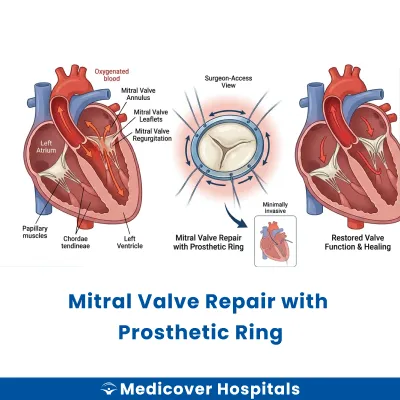
Mitral Valve Repair with Prosthetic Ring is a surgical procedure on the heart. It involves the mitral valve, which regulates blood flow between the left atrium and left ventricle. In this procedure, a prosthetic ring is used to reshape and support the valve. This helps it close properly and prevent blood from leaking backward.
This surgery is needed for conditions like mitral valve regurgitation (leakage) or stenosis (narrowing). If untreated, these can lead to heart failure or other complications. Modern approaches include minimally invasive surgery and robotic-assisted techniques. These methods aim to reduce recovery time and improve outcomes.
Mitral Valve Repair With Prosthetic Ring Doctors Near You
Discover expert ctvs-cardiothoracic-and-vascular-surgery for mitral valve repair with prosthetic ring at Medicover Hospitals. Choose your city and book a consultation today for specialised care.
Why Choose Medicover Hospitals for Mitral Valve Repair With Prosthetic Ring?
Get a second opinion from trusted experts and makeconfident, informed decisions.
 Get Second Opinion
Complete Guide To Mitral Valve Repair With Prosthetic Ring
Everything you need to know about the procedure, preparation, and recovery
Mitral Valve Repair with Prosthetic Ring procedure Indications
Doctors recommend Mitral Valve Repair with a Prosthetic Ring when the mitral valve does not function properly, leading to heart-related symptoms. This procedure is often suggested when conservative treatments are ineffective, and surgical intervention is necessary to restore valve function.
Severe Mitral Regurgitation
Patients may experience breathlessness, fatigue, or palpitations. Echocardiography often reveals significant backward blood flow through the mitral valve. Surgery is considered when symptoms worsen or heart function declines despite medication.
Mitral Valve Prolapse with Symptoms
Individuals may report chest pain, dizziness, or irregular heartbeats. Physical examination and echocardiogram show valve leaflets bulging into the left atrium. Surgery is advised if symptoms persist and affect daily life.
Rheumatic Heart Disease
Patients may have joint pain, fever, or difficulty breathing. Diagnostic tests show valve thickening and dysfunction. When medications do not alleviate symptoms, surgical repair becomes necessary.
Degenerative Mitral Valve Disease
Symptoms include shortness of breath and reduced exercise tolerance. Imaging often shows valve leaflet degeneration. Surgery is recommended when conservative measures fail to improve quality of life.
Endocarditis
Patients may experience fever, chills, and heart murmurs. Blood cultures and echocardiography confirm infection and valve damage. Surgery is needed when antibiotics do not resolve the infection or prevent further valve deterioration.
How to Prepare for Mitral Valve Repair with Prosthetic Ring?
Proper preparation for mitral valve repair with a prosthetic ring is crucial for a smooth surgery and recovery. It helps minimise complications and ensures the best possible outcome.
- Medication Review: Inform your doctor about all medications you're taking, including over-the-counter drugs and supplements.
- Stop Certain Medications: Discontinue NSAIDs, anticoagulants, and herbal supplements as advised by your doctor to reduce bleeding risk.
- Fasting Guidelines: Follow the fasting instructions provided by your healthcare team, typically 8-12 hours before surgery for anaesthesia.
- Pre-Surgery Tests: Complete all required tests like blood work, ECG, or chest X-ray as scheduled.
- Clothing and Personal Items: Wear loose, comfortable clothing and bring a list of your medications with dosages.
- Arrange Transportation: Plan for someone to drive you home post-surgery as you may not be able to drive immediately.
- Hospital Stay Preparation: Pack essentials for your hospital stay, including toiletries and any personal items.
- Follow Pre-Op Instructions: Adhere to any additional pre-operative instructions given by your healthcare provider.
Mitral Valve Repair with Prosthetic Ring procedure (Step-by-Step)
Performed by CTVS (Cardiothoracic and Vascular Surgery) specialists, this procedure typically lasts 3-4 hours and is done under general anaesthesia.
- Preparation: The patient is placed under general anaesthesia. Vital signs are monitored closely. The chest area is cleaned and sterilised.
- Incision: A 6-8 cm incision is made in the chest to access the heart. The sternum is carefully divided to reach the mitral valve.
- Heart Access: The heart is temporarily stopped using a cardioplegic solution. A heart-lung machine maintains blood circulation and oxygenation.
- Valve Exposure: The surgeon uses a retractor to open the heart and access the mitral valve. Instruments like a curette or bipolar cautery may be used to remove any calcifications.
- Ring Placement: A prosthetic ring is sewn around the valve opening. This supports the valve and ensures proper closure. The harmonic scalpel may be used for precise cutting and sealing.
- Closure: The heart is restarted, and the incision is closed with sutures. The sternum is wired back together, and the skin is closed with stitches or staples.
- Recovery: The patient is moved to the ICU for monitoring. Pain management and breathing support are provided as needed.
Who Performs Mitral Valve Repair with Prosthetic Ring procedure?
This procedure is performed by cardiothoracic surgeons who specialise in heart surgeries. They have extensive training in managing complex heart conditions and are skilled in using advanced surgical instruments.
Recovery After Mitral Valve Repair with Prosthetic Ring procedure
Recovery from mitral valve repair with a prosthetic ring involves gradual healing and lifestyle adjustments. Patients can expect to stay in the hospital for a few days post-surgery for monitoring. Full recovery may take several weeks, with improvements in energy levels and reduced symptoms over time.
Day 1-3:
- Hospital stay for close monitoring.
- Pain management and initiation of light breathing exercises.
- Start with a liquid diet, gradually moving to soft foods like soups and khichdi.
Day 4-7:
- Discharge from the hospital, if stable.
- Continue with light activities at home.
- Diet can include soft, easily digestible foods like dal-rice and curd.
- Regular follow-up appointments are crucial.
Week 2-4:
- Gradual increase in physical activity, but avoid strenuous exercises.
- Resume light household tasks.
- Introduce more variety in diet, including moong dal and soft vegetables.
- Most patients can return to work or school after 4 weeks, depending on recovery.
Week 5-8:
- Further increase in activity levels, as tolerated.
- Focus on a balanced diet for heart health.
- Regular check-ups to monitor heart function.
When to Seek Urgent Help:
- Sudden chest pain or shortness of breath.
- Severe swelling in legs or feet.
- Uncontrolled bleeding or signs of infection at the incision site.
- Persistent fever or irregular heartbeats.
Please contact the hospital for current details as insurance panels may change.
Benefits of Mitral Valve Repair with Prosthetic Ring procedure
Mitral valve repair with a prosthetic ring is a surgical procedure aimed at restoring the function of the mitral valve. It offers several benefits for patients with valve issues.
- Improved Heart Function: Enhances blood flow efficiency by stabilising the valve structure.
- Reduced Symptoms: Alleviates symptoms such as shortness of breath and fatigue.
- Durability: The prosthetic ring provides long-term support to the valve.
- Lower Risk of Complications: Compared to valve replacement, repair often has fewer complications.
- Preservation of Heart Tissue: Maintains more of the patient's natural heart tissue.
Risks and Complications of Mitral Valve Repair with Prosthetic Ring procedure
While generally safe, mitral valve repair with a prosthetic ring carries some risks and potential complications.
- Bleeding during or after surgery.
- Infection at the surgical site or in the heart.
- Blood clots leading to stroke or other complications.
- Ring dehiscence, where the ring becomes loose.
- Arrhythmias or irregular heartbeats post-surgery.
- Valve dysfunction requiring further intervention.
Common Risks:
Rare Complications:
Cost of Mitral Valve Repair with Prosthetic Ring procedure
The cost of a Mitral Valve Repair with Prosthetic Ring procedure typically ranges from Rs. 3,00,000 to Rs. 4,80,000, depending on factors like the surgical approach, duration of hospital stay, room category, required diagnostics, and post-operative care.
Medicover Hospitals offers transparent pricing and supports insurance and TPA services, including CGHS, ESI, and major TPAs. A cashless facility is available for ease of payment. Please contact the hospital for the latest insurance panel details as these may change periodically.
Frequently Asked Questions
1. How much does Mitral Valve Repair with Prosthetic Ring procedure cost at Medicover Hospitals?
The cost for Mitral Valve Repair with Prosthetic Ring typically ranges from Rs. 3,00,000 to Rs. 4,80,
2. Please contact Medicover Hospitals for detailed pricing information. 2. Is Mitral Valve Repair with Prosthetic Ring procedure covered under health insurance at Medicover?
Many insurance plans, including CGHS and ESI, may cover this procedure. Please contact the hospital for current panel details.
3. Will I feel shortness of breath after mitral valve repair?
Some patients may experience shortness of breath initially. This usually improves as the heart adjusts post-surgery.
4. Can I resume normal activities after mitral valve repair?
You can gradually resume normal activities after 6-8 weeks. It's important to follow your doctor's advice for a safe recovery.
5. Will I need blood thinners after mitral valve repair?
Blood thinners may be required to prevent clots after surgery. Your doctor will provide specific guidance based on your condition.
6. What foods should I avoid after mitral valve repair?
Avoid high-sodium foods and opt for healthy options like dal-rice and khichdi. Consult your doctor for a personalized diet plan.
7. Is fatigue common after mitral valve repair?
Fatigue is common as your body heals from surgery. Rest and gradual activity increase can help improve energy levels over time.


