 Call
Call Patient Reports
Best Mini Percutaneous Nephrolithotomy with Stent Placement Hospital
Mini Percutaneous Nephrolithotomy with Stent Placement at Medicover Hospitals is performed using an endoscopic approach. Our team of MS, DNB, and MCh qualified urologists ensures precise treatment. This procedure typically results in smaller incisions and reduced blood loss, facilitating quicker recovery.
Expert Surgeons
Yearly Surgeries
Patient Satisfaction
What is Mini Percutaneous Nephrolithotomy With Stent Placement?
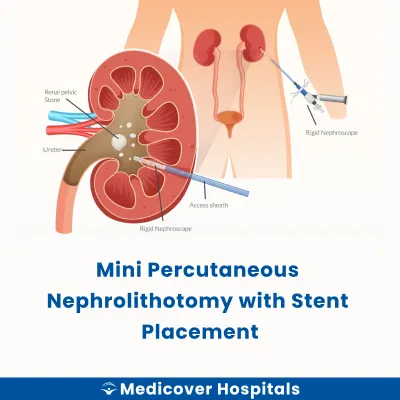
Mini Percutaneous Nephrolithotomy with Stent Placement is a minimally invasive procedure to remove kidney stones. It involves making a small incision in the back to access the kidney (renal organ) and remove stones. A stent (a small tube) is placed to ensure urine flow and aid healing. This procedure is less invasive than traditional surgery, offering quicker recovery.
This surgery is needed for large or complex kidney stones that cannot pass naturally. Untreated stones can cause severe pain, infections, or kidney damage. Conditions like recurrent urinary tract infections or blockages may lead to this procedure. Modern approaches include using advanced imaging and laser technology to enhance precision and effectiveness.
Mini Percutaneous Nephrolithotomy With Stent Placement Doctors Near You
Discover skilled urologists for mini percutaneous nephrolithotomy with stent placement at Medicover Hospitals across India. Choose your city and book a consultation today for expert care.
Why Choose Medicover Hospitals for Mini Percutaneous Nephrolithotomy With Stent Placement?
Get a second opinion from trusted experts and makeconfident, informed decisions.
 Get Second Opinion
Complete Guide To Mini Percutaneous Nephrolithotomy With Stent Placement
Everything you need to know about the procedure, preparation, and recovery
Mini Percutaneous Nephrolithotomy with Stent Placement procedure Indications
Doctors recommend Mini Percutaneous Nephrolithotomy with Stent Placement when kidney stones are too large or complex to pass naturally. This procedure is often chosen when other non-invasive treatments have failed.
Large Kidney Stones
Patients may experience severe pain in the back or side, nausea, and blood in the urine. Imaging tests like an ultrasound or CT scan reveal stones larger than 2 cm. When medication and hydration do not help, this procedure is considered.
Complex Stone Composition
Some patients have stones made of cystine or struvite, which are hard to break down. Symptoms include recurrent urinary tract infections and persistent pain. When these stones do not respond to shock wave therapy, surgical intervention is needed.
Obstructive Uropathy
Patients may face difficulty urinating and experience flank pain. Tests show that stones are blocking urine flow, causing kidney swelling. When drainage and medication fail, this procedure is advised to relieve obstruction.
Recurrent Stone Formation
Patients with frequent stone episodes often have metabolic disorders. Symptoms include repeated pain and urinary infections. When lifestyle changes and medications do not prevent new stones, surgical removal is necessary.
Failed Previous Treatments
Some patients have undergone shock wave lithotripsy or ureteroscopy without success. Persistent pain and stone presence in imaging tests indicate the need for this procedure to ensure stone removal.
How to Prepare for Mini Percutaneous Nephrolithotomy with Stent Placement?
Proper preparation is crucial for a smooth Mini Percutaneous Nephrolithotomy with Stent Placement. It helps reduce risks and ensures a successful procedure.
- Medication Review: Stop NSAIDs, anticoagulants, and herbal supplements at least 7 days before surgery.
- Fasting Guidelines: Do not eat or drink anything for 8 hours before the procedure to ensure safety during anaesthesia.
- Pre-Surgery Tests: Complete any blood tests or imaging studies as advised by your doctor.
- Hydration: Drink plenty of water the day before, but stop as instructed before fasting begins.
- Clothing: Wear loose, comfortable clothing on the day of surgery for ease of movement post-procedure.
- Transportation: Arrange for someone to drive you home after the procedure, as you may feel drowsy.
- Medication List: Bring a list of your current medications with dosages for the medical team.
- Post-Op Care: Discuss any specific post-operative care instructions with your doctor beforehand.
Mini Percutaneous Nephrolithotomy with Stent Placement procedure (Step-by-Step)
This procedure is performed by expert urologists. It typically lasts 1 to 2 hours and is done under general anaesthesia.
- Preparation: The patient is positioned on their abdomen. General anaesthesia is administered to ensure comfort and pain-free experience.
- Access Creation: A small incision, about 1-2 cm, is made in the back. A trocar is used to access the kidney.
- Nephroscope Insertion: A nephroscope is inserted through the incision to locate and visualize the kidney stones.
- Stone Fragmentation: Stones are broken into smaller pieces using a laser or ultrasonic device. This allows for easier removal.
- Stone Removal: The fragmented stones are removed using forceps or suction through the nephroscope.
- Stent Placement: A stent is placed in the ureter to ensure proper urine flow and aid healing. This is done using a guidewire and cystoscope.
- Closure and Recovery: The incision is closed with sutures or surgical glue. The patient is monitored as they wake from anaesthesia.
Who Performs Mini Percutaneous Nephrolithotomy with Stent Placement procedure?
This procedure is performed by urologists. They are specialists trained in the urinary tract and male reproductive organs. Urologists have expertise in minimally invasive techniques for kidney stone removal.
Recovery After Mini Percutaneous Nephrolithotomy with Stent Placement procedure
Recovery from Mini Percutaneous Nephrolithotomy with Stent Placement involves gradual improvement over a few weeks. Patients can expect some discomfort initially, but it typically subsides as healing progresses.
Day 1-3:
- Rest is crucial. Avoid strenuous activities.
- Stay hydrated. Drink plenty of water to help flush out any remaining stone fragments.
- Consume light meals like curd, dal-rice, and soups to avoid digestive discomfort.
Day 4-7:
- Gradually increase activity levels. Short walks are beneficial.
- Continue with a soft diet. Include foods like khichdi and moong dal for easy digestion.
- Monitor for any signs of infection or unusual symptoms.
Week 2:
- Most patients can resume work or school, depending on their comfort and doctor's advice.
- Normal diet can be resumed, but maintain hydration and avoid excessive salt intake.
- Follow up with your doctor for stent removal if advised.
When to Seek Urgent Help:
- Severe pain not relieved by medication.
- Fever or chills indicating possible infection.
- Blood in urine that is persistent or worsening.
- Difficulty urinating or a significant decrease in urine output.
Benefits of Mini Percutaneous Nephrolithotomy with Stent Placement procedure
Mini Percutaneous Nephrolithotomy (PCNL) with stent placement is a minimally invasive procedure to remove kidney stones.
- Minimally Invasive: Smaller incisions lead to quicker recovery and less scarring.
- Effective Stone Removal: High success rate in removing large or complex stones.
- Shorter Hospital Stay: Patients often experience reduced hospitalisation time.
- Reduced Pain: Less postoperative pain compared to traditional surgery.
- Stent Benefits: Helps in drainage and prevents blockage during healing.
Risks and Complications of Mini Percutaneous Nephrolithotomy with Stent Placement procedure
While generally safe, Mini PCNL with stent placement carries some risks and potential complications.
- Common: Bleeding may occur during or after the procedure.
- Common: Infection risk due to the introduction of instruments into the kidney.
- Rare: Injury to surrounding organs or tissues.
- Rare: Fluid accumulation around the kidney, known as urinoma.
- Rare: Allergic reactions to anaesthesia or contrast dye.
- Rare: Stent-related discomfort or urinary symptoms.
Cost of Mini Percutaneous Nephrolithotomy with Stent Placement procedure
The cost for Mini Percutaneous Nephrolithotomy with Stent Placement at Medicover Hospitals varies based on the ward category chosen. Prices range from Rs. 30,000 to Rs. 290,000 across different ward types. Our pricing is transparent, and we offer support for insurance and TPA, including CGHS, ESI, and major TPAs. Cashless facilities are available for your convenience. Please contact the hospital for the latest insurance panel details as these may change periodically.
Frequently Asked Questions
1. How much does Mini Percutaneous Nephrolithotomy with Stent Placement procedure cost at Medicover Hospitals?
The cost for Mini Percutaneous Nephrolithotomy with Stent Placement ranges from Rs. 30,000 to Rs. 2,90,000 across Medicover Hospitals.
2. Is Mini Percutaneous Nephrolithotomy with Stent Placement procedure covered under health insurance at Medicover?
Yes, it is often covered by CGHS, ESI, and major TPAs. Please contact the hospital for current panel details.
3. Will I need a stent after kidney stone removal?
Yes, a stent is usually placed to ensure proper urine flow after the procedure. It helps prevent blockage and aids in healing.
4. Can I resume normal activities after kidney stone surgery?
You may resume light activities within a week, but avoid heavy lifting. Full recovery usually takes 2-4 weeks.
5. What foods should I avoid after kidney stone surgery?
Avoid high-oxalate foods like spinach and nuts. Stick to a diet with curd, dal-rice, and khichdi for easy digestion.
6. Is blood in urine normal after kidney stone surgery?
Yes, slight blood in urine is common for a few days post-surgery. If it persists, consult your doctor immediately.
7. Can kidney stones recur after surgery?
Yes, kidney stones can recur if preventive measures are not followed. Maintain hydration and dietary changes to reduce risk.
8. Is percutaneous surgery major surgery?
Percutaneous Nephrolithotomy is considered minimally invasive, not major open surgery, because it uses a small skin incision. However, it is still a significant procedure performed under anesthesia and requires hospital care.
9. How long is mini PCNL surgery?
Mini PCNL usually takes about 45 minutes to 2 hours, depending on the size and number of kidney stones. Complex cases may take slightly longer.
10. Is PCNL a risky surgery?
PCNL is generally safe with a high success rate, but like any surgery, it carries some risks such as bleeding, infection, or injury to nearby structures. Serious complications are uncommon when performed by experienced urologists.


