 Call
Call Patient Reports
Best Hospital for Medial Collateral Ligament Reconstruction with Advanced Orthopedic Care
At Medicover Hospitals, our orthopedic team performs Medial Collateral Ligament Reconstruction using open surgical techniques. With qualifications like MS and DNB, our surgeons address complex ligament injuries. This approach often results in smaller incisions and reduced blood loss, enhancing patient recovery.
Expert Surgeons
Yearly Surgeries
Patient Satisfaction
What is Medial Collateral Ligament Reconstruction?
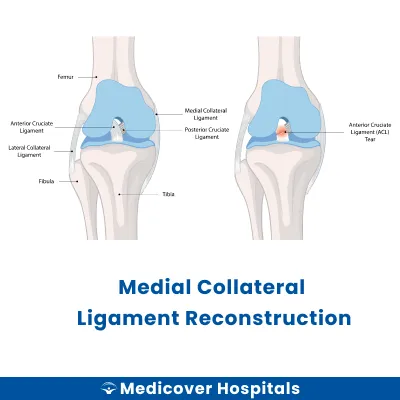
Medial Collateral Ligament Reconstruction is a surgical procedure to repair the medial collateral ligament (MCL) in the knee. The MCL is a band of tissue on the inner side of the knee. It helps stabilize the joint. This surgery involves replacing the damaged ligament with a graft, which can be a tendon from the patient's body or a donor.
This surgery is needed when the MCL is torn or severely damaged. Such injuries often occur due to sports or accidents. Without treatment, the knee may become unstable, leading to further damage. Modern surgical approaches include arthroscopic techniques and minimally invasive methods. These help in quicker recovery and less post-operative pain.
Medial Collateral Ligament Reconstruction Doctors Near You
Discover skilled orthopedics for medial collateral ligament reconstruction at Medicover Hospitals across India. Choose your city and book a consultation to explore expert care options near you.
Why Choose Medicover Hospitals for Medial Collateral Ligament Reconstruction?
Get a second opinion from trusted experts and makeconfident, informed decisions.
 Get Second Opinion
Complete Guide To Medial Collateral Ligament Reconstruction
Everything you need to know about the procedure, preparation, and recovery
Medial Collateral Ligament Reconstruction Surgery Indications
Doctors may recommend Medial Collateral Ligament (MCL) Reconstruction Surgery when the ligament is severely damaged. This procedure is often considered when non-surgical treatments do not relieve symptoms or restore knee stability.
Severe MCL Tear
Patients often experience significant knee pain and instability. Physical examination may reveal joint laxity. MRI scans confirm a complete tear. Surgery is advised when bracing and physiotherapy fail to improve stability.
Chronic Knee Instability
Patients report frequent knee buckling or giving way during activities. Clinical tests show persistent instability despite rehabilitation efforts. Surgery becomes necessary when instability affects daily activities.
Failed Conservative Treatment
Patients have ongoing pain and instability despite months of physiotherapy and bracing. Imaging shows no healing progress. Surgery is considered when conservative measures do not restore function.
Associated Ligament Injuries
Patients with multiple ligament injuries experience severe knee instability. MRI reveals damage to other ligaments along with the MCL. Surgical intervention is needed to restore knee function.
High-Demand Athletes
Athletes report inability to return to sports due to knee instability. Examination shows significant laxity affecting performance. Surgery is recommended when non-surgical options fail to meet athletic demands.
How to Prepare for Medial Collateral Ligament Reconstruction?
Proper preparation for Medial Collateral Ligament Reconstruction can enhance recovery and reduce complications. It ensures you are physically and mentally ready for the procedure.
- Medication Review: Stop NSAIDs, anticoagulants, and herbal supplements as advised by your doctor.
- Fasting Guidelines: Fast for at least 8 hours before the surgery if general anaesthesia is used.
- Pre-Surgical Exercises: Perform any recommended exercises to strengthen surrounding muscles, if advised.
- Clothing: Wear loose, comfortable clothing on the day of surgery for ease of dressing post-procedure.
- Transportation: Arrange for someone to drive you home after the surgery as you may not be able to drive yourself.
- Medication List: Bring a list of all medications you are currently taking, including dosages, for hospital records.
- Pre-Op Instructions: Follow any additional specific instructions provided by your healthcare team.
- Home Preparation: Prepare your home for easy access and comfort during recovery, such as setting up a resting area.
Medial Collateral Ligament Reconstruction Surgery (Step-by-Step)
This procedure is performed by orthopaedic surgeons. It typically lasts 1-2 hours. General or regional anaesthesia is used to ensure the patient feels no pain during the surgery.
- Preparation: The patient is positioned on the operating table. The surgical area is cleaned and sterilised.
- Incision: A small incision, about 3-4 cm, is made on the inner side of the knee to access the medial collateral ligament (MCL).
- Harvesting Graft: A graft is taken from the patient's own tissue, often from the hamstring tendon, to replace the damaged MCL.
- Graft Placement: The graft is positioned and secured in place using surgical instruments like a curette and a trocar. This helps in stabilising the knee.
- Fixation: The graft is fixed using screws or other fixation devices to ensure it remains in place as it heals.
- Closure: The incision is closed with sutures or staples. The area is then bandaged to protect the wound.
- Recovery: The patient is moved to a recovery room. They are monitored as the anaesthesia wears off. Pain management is provided as needed.
Who Performs Medial Collateral Ligament Reconstruction Surgery?
This surgery is performed by orthopedic surgeons who specialise in knee injuries and ligament reconstruction. They are trained to handle complex knee procedures and use specialised instruments to achieve the best outcomes for patients.
Recovery After Medial Collateral Ligament Reconstruction Surgery
Recovery from Medial Collateral Ligament (MCL) Reconstruction Surgery involves gradual healing and rehabilitation. Expect to follow a structured recovery plan to regain strength and mobility.
Day 1-3:
- Rest and elevate the leg to reduce swelling.
- Apply ice packs as advised by your doctor.
- Begin gentle movements to prevent stiffness.
- Stick to a light diet with foods like curd, dal-rice, and soups.
Day 4-7:
- Continue with prescribed pain medications.
- Start physiotherapy exercises as recommended.
- Introduce soft foods like khichdi and moong dal for easy digestion.
- Limit walking and use crutches if needed.
Week 2-4:
- Gradually increase physical activity under guidance.
- Focus on strengthening exercises for the knee.
- Return to work or school may be possible if it involves minimal physical activity.
- Maintain a balanced diet to support healing.
Phase 2 (Week 5-8):
- Increase intensity of physiotherapy sessions.
- Start low-impact activities like cycling or swimming.
- Continue with a nutritious diet including proteins and vitamins.
- Avoid high-impact sports or heavy lifting.
When to Seek Urgent Help:
- Severe pain unrelieved by medication.
- Excessive swelling or redness around the knee.
- Fever or chills indicating possible infection.
- Sudden inability to move the knee.
Benefits of Medial Collateral Ligament Reconstruction Surgery
Medial Collateral Ligament (MCL) Reconstruction can help restore knee stability and function. Here are some benefits:
- Improved Stability: Helps in regaining knee stability, reducing the risk of future injuries.
- Enhanced Mobility: Allows for better movement and flexibility in the knee joint.
- Pain Reduction: Alleviates pain associated with MCL injuries, improving quality of life.
- Return to Activities: Enables a quicker return to sports and daily activities.
Risks and Complications of Medial Collateral Ligament Reconstruction Surgery
While MCL Reconstruction is generally safe, like any surgery, it carries some risks. It's important to be aware of them:
- Swelling and stiffness in the knee post-surgery.
- Pain around the surgical area during recovery.
- Infection at the site of surgery.
- Blood clots forming in the leg.
- Nerve or blood vessel damage during the procedure.
- Graft failure or loosening over time.
What is the Cost of Medial Collateral Ligament Reconstruction Surgery?
The cost of Medial Collateral Ligament Reconstruction Surgery at Medicover Hospitals ranges from Rs. 79,000 to Rs. 204,000. The price varies depending on the ward category chosen, such as general, twin sharing, private, or ICU.
We offer transparent pricing and support for insurance and TPA, including CGHS, ESI, and major TPAs. Cashless facilities are available to ease the financial process. Please contact the hospital for the latest insurance panel details as these may change periodically.
Frequently Asked Questions
1. How much does Medial Collateral Ligament Reconstruction surgery cost at Medicover Hospitals?
The cost for Medial Collateral Ligament Reconstruction surgery at Medicover Hospitals ranges from Rs. 79,000 to Rs. 204,000, depending on the type of room chosen.
2. Is Medial Collateral Ligament Reconstruction surgery covered under health insurance at Medicover?
Medial Collateral Ligament Reconstruction surgery is often covered by CGHS, ESI, and major TPAs. Please contact the hospital for current panel details.
3. Will I need crutches after MCL reconstruction?
Yes, crutches are usually needed for a few weeks post-surgery to aid mobility and support the knee during initial recovery.
4. Can I drive after MCL reconstruction?
Driving is typically not recommended for at least 6 weeks after MCL reconstruction to ensure proper knee stability and safety.
5. Will my knee be swollen after MCL reconstruction?
Swelling is common after MCL reconstruction and can last several weeks. Ice packs and elevation help reduce swelling.
6. Can I play sports after MCL reconstruction?
Return to sports is usually possible after 6-9 months, depending on recovery progress and doctor's advice.
7. What foods aid recovery after MCL reconstruction?
Eating protein-rich foods like dal, curd, and lean meats, along with fruits and vegetables, supports healing after MCL reconstruction.


