 Call
Call Patient Reports
Functional Cast Brace Application Procedure at Medicover Hospitals
At Medicover Hospitals, our orthopaedic team specialises in the open surgical approach for Functional Cast Brace Application. With qualifications like MS and DNB, our experts treat various orthopaedic conditions. This method often results in shorter hospital stays and effective recovery across India.
Expert Specialists
Yearly Procedures
Patient Satisfaction
What is Functional Cast Brace Application?
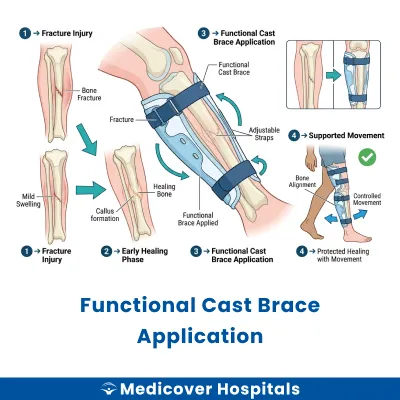
Functional Cast Brace Application is a medical procedure used to support and stabilize a fractured limb, typically the arm or leg. It involves the application of a brace that allows some movement while maintaining alignment. This helps in the healing process by promoting circulation and muscle activity, which are crucial for recovery.
This procedure is often needed for fractures that require stability but benefit from some mobility. Conditions like fractures of the tibia (shinbone) or radius (forearm bone) may necessitate this approach. If left untreated, these fractures can lead to improper healing or deformity. Modern surgical approaches include minimally invasive techniques and advanced materials for braces, enhancing patient comfort and recovery.
Functional Cast Brace Application Doctors Near You
Find expert orthopedics for functional cast brace application at Medicover Hospitals across India. Choose your city and book a consultation to receive specialised care tailored to your needs.
Why Choose Medicover Hospitals for Functional Cast Brace Application?
Get a second opinion from trusted experts and makeconfident, informed decisions.
 Get Second Opinion
Complete Guide To Functional Cast Brace Application
Everything you need to know about the procedure, preparation, and recovery
Functional Cast Brace Application procedure Indications
Doctors recommend the Functional Cast Brace Application to support healing in certain fractures. It allows for some movement while maintaining stability, aiding in quicker recovery.
Stable Fractures
Patients may experience mild to moderate pain and swelling at the fracture site. X-rays show a stable fracture with minimal displacement. When initial immobilisation with a traditional cast is successful, but prolonged immobilisation is not ideal, a functional cast brace is considered.
Post-Surgical Fracture Management
After surgical fixation of fractures, patients might have reduced pain but require support to ensure proper alignment. Imaging confirms stable post-operative alignment. When the patient is ready to begin limited movement, a functional cast brace is used to facilitate this transition.
Fractures with Soft Tissue Injury
Patients often report pain and swelling, with possible bruising around the fracture. Examination reveals soft tissue involvement. Once initial swelling decreases and the fracture is stable, a functional cast brace helps in managing both bone and soft tissue healing.
Rehabilitation Phase of Fractures
Patients may have reduced pain but still experience stiffness. X-rays show satisfactory healing progress. When the fracture is stable but requires gradual mobilisation, a functional cast brace supports this phase.
Fractures in Active Individuals
Active patients often experience pain and limited movement. Imaging shows stable fractures. When traditional casting limits their activity excessively, a functional cast brace allows for controlled movement while maintaining fracture stability.
How to Prepare for Functional Cast Brace Application?
Proper preparation is crucial for a smooth Functional Cast Brace Application. It ensures the procedure is effective and reduces the risk of complications. Follow these steps to get ready:
- Medication Review: Stop NSAIDs, anticoagulants, and herbal supplements at least 7 days before the procedure.
- Fasting Guidelines: If general anaesthesia is used, fast for 8 hours before the procedure. Clear liquids are allowed up to 2 hours prior.
- Skin Preparation: Clean the affected area thoroughly. Avoid applying lotions or creams on the day of the procedure.
- Clothing: Wear loose, comfortable clothing that can easily accommodate the cast brace.
- Transportation: Arrange for someone to drive you home after the procedure, as you may not be able to drive yourself.
- Medication List: Bring a list of all medications you are currently taking, including dosages.
- Pre-Procedure Instructions: Follow any specific instructions provided by your healthcare provider regarding the affected limb.
- Communication: Inform your doctor of any hypersensitivity issues or medical conditions that may affect the procedure.
Functional Cast Brace Application procedure (Step-by-Step)
Overview: This procedure is performed by orthopaedic specialists. It typically lasts 30-60 minutes and is usually done under local anaesthesia.
- Assessment: The orthopaedic specialist evaluates the injury. They decide if a functional cast brace is suitable.
- Preparation: The affected area is cleaned and sterilised. The patient may feel a cool sensation from the antiseptic solution.
- Positioning: The limb is positioned correctly to ensure proper alignment. The patient should remain still during this phase.
- Application of Padding: Soft padding is applied to protect the skin. This step ensures comfort and prevents irritation.
- Cast Application: A fibreglass or plaster cast is applied over the padding. The patient may feel warmth as the material sets.
- Brace Fitting: A functional brace is fitted over the cast. This allows for controlled movement and aids in healing.
- Final Adjustments: The brace is adjusted for comfort and functionality. The patient should report any discomfort immediately.
Who Performs Functional Cast Brace Application procedure?
Orthopaedic specialists perform the functional cast brace application. They have expertise in managing bone and joint injuries. Their skills ensure the brace is applied correctly, promoting effective healing. Please contact the hospital for current details as insurance panels may change.
Recovery After Functional Cast Brace Application procedure
Recovering from a Functional Cast Brace Application involves gradual healing and adaptation to the brace. Patients can expect some discomfort initially, but this should ease as the body adjusts. Adhering to the doctor's instructions is crucial for a smooth recovery.
Day 1-3:
- Rest is essential. Keep the affected limb elevated to reduce swelling.
- Apply ice packs as advised to manage pain and swelling.
- Consume light meals like curd and dal-rice to maintain energy levels.
Day 4-7:
- Begin gentle movements as recommended to prevent stiffness.
- Continue with a balanced diet including khichdi and moong dal for protein.
- Avoid putting weight on the affected area unless instructed.
Week 2-4:
- Gradually increase activity levels, but avoid strenuous tasks.
- Incorporate soups and fresh fruits for vitamins and minerals.
- Attend follow-up appointments for brace adjustments.
Phase 1 Month and Beyond:
- Resume work or school if mobility allows and with medical clearance.
- Engage in prescribed physiotherapy exercises to regain strength.
- Monitor the brace fit and report any discomfort to the doctor.
When to Seek Urgent Help
- Severe pain unrelieved by medication.
- Increased swelling or redness around the brace.
- Numbness or tingling in the affected limb.
- Foul odour or discharge from under the brace.
Benefits of Functional Cast Brace Application procedure
The Functional Cast Brace Application is a technique used to aid in the healing of fractures while allowing some degree of movement.
- Mobility Support: Enables partial movement, promoting muscle activity and circulation.
- Enhanced Comfort: Designed to be more comfortable than traditional casts.
- Improved Healing: Facilitates faster recovery by allowing controlled motion.
- Custom Fit: Tailored to the patient's specific needs, ensuring better support.
Risks and Complications of Functional Cast Brace Application procedure
While generally safe, the Functional Cast Brace Application procedure carries some risks and complications.
Common Risks
- Skin irritation or pressure sores due to prolonged wear.
- Swelling if the brace is too tight or improperly fitted.
Rare Risks
- Infection if the skin is broken or not kept clean.
- Delayed healing if the brace does not provide adequate support.
- Nerve damage from improper application or excessive pressure.
Cost of Functional Cast Brace Application procedure
The cost of the Functional Cast Brace Application procedure ranges from ₹1,200 to ₹4,000 across Medicover Hospitals. The price varies depending on the ward category chosen, such as outpatient, day care, or private rooms.
We offer transparent pricing and support for insurance and TPA services, including CGHS, ESI, and major TPAs. A cashless facility is also available for your convenience. Please contact the hospital for the latest insurance panel details as these may change periodically.
Frequently Asked Questions
1. How much does Functional Cast Brace Application procedure cost at Medicover Hospitals?
The cost for Functional Cast Brace Application ranges from ₹1,200 to ₹4,000 across Medicover Hospitals, depending on the type of cast and care level.
2. Is Functional Cast Brace Application procedure covered under health insurance at Medicover?
Functional Cast Brace Application may be covered under CGHS, ESI, and major TPAs with cashless options. Please contact the hospital for current panel details.
3. Can I drive with a functional cast brace?
Driving with a functional cast brace is generally not advised due to restricted movement. Consult your doctor for specific recommendations based on your condition.
4. Will my arm swell after applying the cast?
Some swelling is normal after applying a functional cast brace. Elevate your arm and apply ice packs to reduce swelling.
5. Can I shower with a functional cast brace?
Showering with a functional cast brace is not recommended as water can damage the cast. Use a waterproof cover or sponge baths instead.
6. How soon can I return to sports after cast removal?
Returning to sports typically takes a few weeks post-cast removal. Follow your physiotherapist's guidance for a gradual return to activities.
7. Will I need physiotherapy after cast removal?
Physiotherapy is often recommended after cast removal to regain strength and mobility. Exercises may include gentle stretches and strengthening routines.


