 Call
Call Patient Reports
Dual Chamber Implantable Cardioverter Defibrillator Implantation Procedure Hospital
Dual chamber implantable cardioverter defibrillator implantation at Medicover Hospitals is performed using an open surgical approach. Our cardiologists, with qualifications like DM and DNB, ensure precise placement. This procedure often results in shorter hospital stays for patients across India.
Expert Surgeons
Yearly Surgeries
Patient Satisfaction
What is Dual Chamber Implantable Cardioverter Defibrillator Implantation?
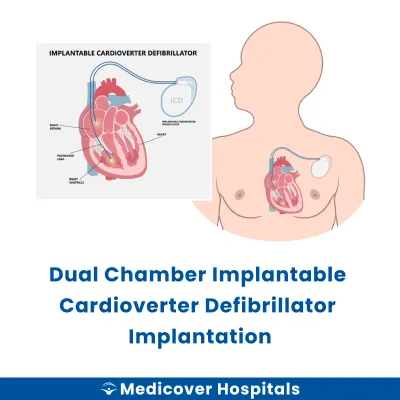
Dual chamber implantable cardioverter defibrillator implantation is a medical procedure involving the heart. It involves placing a device that monitors and regulates heart rhythms. The device has two leads, one in the atrium and one in the ventricle. It helps in detecting and correcting irregular heartbeats (arrhythmias) by delivering electrical shocks when needed.
This surgery is essential for patients with life-threatening arrhythmias or heart failure. Conditions like ventricular tachycardia or fibrillation may require this procedure. If untreated, these conditions can lead to cardiac arrest or sudden death. Modern surgical approaches include minimally invasive techniques, which reduce recovery time and complications. These methods ensure the device is placed accurately and functions effectively.
Dual Chamber Implantable Cardioverter Defibrillator Implantation Doctors Near You
Find expert cardiologists for dual chamber implantable cardioverter defibrillator implantation at Medicover Hospitals across India. Choose your city and book a consultation to discuss your heart health needs.
Why Choose Medicover Hospitals for Dual Chamber Implantable Cardioverter Defibrillator Implantation?
Get a second opinion from trusted experts and makeconfident, informed decisions.
 Get Second Opinion
Complete Guide To Dual Chamber Implantable Cardioverter Defibrillator Implantation
Everything you need to know about the procedure, preparation, and recovery
Dual chamber implantable cardioverter defibrillator implantation procedure Indications
Doctors recommend dual chamber implantable cardioverter defibrillator (ICD) implantation when a patient is at risk of life-threatening heart rhythms. This procedure helps manage and prevent sudden cardiac arrest by restoring normal heart rhythm.
Symptomatic Bradycardia with Ventricular Tachycardia
Patients may experience dizziness, fatigue, or fainting due to slow heart rates combined with episodes of fast heart rhythms. Doctors find irregular heartbeats on ECG and Holter monitoring. When medication fails to manage symptoms, ICD implantation is considered.
Heart Failure with Reduced Ejection Fraction
Individuals often suffer from breathlessness, swelling, and fatigue. Echocardiograms reveal a reduced ejection fraction, indicating weakened heart pumping. When standard heart failure treatments do not prevent arrhythmias, an ICD may be recommended.
Post-Myocardial Infarction with Arrhythmias
After a heart attack, patients might experience palpitations or chest discomfort. ECGs and stress tests show abnormal rhythms. If medications and lifestyle changes do not control these arrhythmias, an ICD can be necessary.
Syncope with Documented Arrhythmias
Patients report sudden fainting spells. ECGs or event monitors capture abnormal heart rhythms during these episodes. When other treatments do not prevent syncope, an ICD is advised.
Congenital Heart Disease with Arrhythmias
Patients may have palpitations or shortness of breath due to structural heart issues. Imaging and ECGs reveal arrhythmias linked to congenital defects. If symptoms persist despite medical management, an ICD is considered.
How to Prepare for Dual Chamber Implantable Cardioverter Defibrillator Implantation?
Proper preparation is crucial for a successful dual chamber implantable cardioverter defibrillator (ICD) implantation. It helps minimise risks and ensures a smoother procedure and recovery.
- Medication Review: Discuss all medications with your doctor. You may need to stop NSAIDs, anticoagulants, and herbal supplements a few days before the procedure.
- Fasting: Do not eat or drink anything for at least 6-8 hours before the procedure, as general anaesthesia is typically used.
- Medical History: Bring a list of your current medications, including dosages, to the hospital.
- Clothing: Wear loose, comfortable clothing on the day of the procedure to avoid discomfort.
- Transportation: Arrange for someone to drive you home after the procedure, as you will not be able to drive yourself.
- Pre-Procedure Tests: Complete any required blood tests or imaging studies as instructed by your healthcare provider.
- Smoking and Alcohol: Avoid smoking and alcohol for at least 24 hours before the procedure to reduce complications.
- Follow Instructions: Adhere to any additional instructions provided by your healthcare team for optimal results.
Dual chamber implantable cardioverter defibrillator implantation procedure (Step-by-Step)
This procedure is performed by cardiologists. It typically takes 2-3 hours and is done under local anaesthesia with sedation.
- Preparation: The patient is positioned comfortably on the operating table. Local anaesthesia is administered to numb the area where the device will be implanted.
- Incision: A small incision, about 5-7 cm, is made below the collarbone. The patient may feel some pressure but no pain.
- Lead Insertion: Using a trocar, leads are carefully guided through a vein into the heart chambers. The patient might feel slight discomfort as the leads are positioned.
- Device Placement: The dual chamber ICD is connected to the leads and placed in a pocket created under the skin. The patient remains comfortable during this step.
- Testing: The device is tested to ensure proper function. The patient may feel a mild sensation as the device delivers a test shock.
- Closure: The incision is closed with sutures or staples. The area is then bandaged. The patient is monitored for a short period before being moved to recovery.
- Recovery: The patient is taken to a recovery area to rest and is observed for any immediate complications.
Who Performs Dual chamber implantable cardioverter defibrillator implantation procedure?
This procedure is performed by interventional heart doctors. They specialise in diagnosing and treating heart conditions using catheter-based techniques. Their expertise ensures the precise placement and functioning of the device.
Recovery After Dual Chamber Implantable Cardioverter Defibrillator Implantation Procedure
Recovery from a dual chamber implantable cardioverter defibrillator (ICD) implantation involves gradual healing and adjustment. Patients can expect some discomfort initially, but most return to daily activities within a few weeks.
Day 1-3:
- Rest is crucial. Avoid strenuous activities.
- Keep the incision site clean and dry.
- Eat light meals like khichdi or moong dal to avoid digestive strain.
Day 4-7:
- Gradually increase light activities like walking.
- Continue with a soft diet, including curd and dal-rice.
- Avoid lifting heavy objects or raising the arm on the side of the implant.
Day 8-14:
- Most patients can resume work or school, depending on the nature of their job.
- Incorporate more variety in diet, such as soups and steamed vegetables.
- Monitor the incision for signs of infection.
Phase 3 (Week 3-6):
- Resume normal activities, but avoid contact sports.
- Follow up with your doctor for a device check.
- Maintain a balanced diet with plenty of fruits and vegetables.
When to Seek Urgent Help
- Severe pain or swelling at the incision site.
- Fever or chills indicating possible infection.
- Shortness of breath or chest pain.
- Unusual heart palpitations or dizziness.
Benefits of Dual chamber implantable cardioverter defibrillator implantation procedure
The dual chamber implantable cardioverter defibrillator (ICD) offers several advantages for patients with specific heart conditions.
- Enhanced Heart Rhythm Management: It helps in maintaining a stable heart rhythm by coordinating the upper and lower chambers of the heart.
- Prevention of Sudden Cardiac Arrest: The device can detect and correct life-threatening arrhythmias, reducing the risk of sudden cardiac arrest.
- Improved Quality of Life: Patients may experience fewer symptoms like dizziness and fainting, leading to a better quality of life.
- Customised Therapy: The dual chamber ICD can be programmed to meet individual heart rhythm needs, offering tailored treatment.
Risks and Complications of Dual chamber implantable cardioverter defibrillator implantation procedure
While the procedure is generally safe, there are potential risks and complications to consider.
- Common: Infection at the implant site can occur, requiring medical attention.
- Common: Bleeding or bruising around the implant area is possible post-surgery.
- Rare: Lead displacement may happen, affecting the device's function.
- Rare: Allergic reactions to the device materials can occur in some patients.
- Rare: Pneumothorax disease, or air leakage into the space between the lung and chest wall, may develop.
Cost of Dual chamber implantable cardioverter defibrillator implantation procedure
The cost for a dual chamber implantable cardioverter defibrillator implantation procedure at Medicover Hospitals ranges from Rs. 132,000 to Rs. 245,000. The price varies based on the ward category chosen, such as general, private, or deluxe. We offer transparent pricing and support for insurance and TPA, including CGHS, ESI, and major TPAs. A cashless facility is also available for your convenience. Please contact the hospital for the latest insurance panel details as these may change periodically.
Frequently Asked Questions
1. How much does Dual chamber ICD implantation cost?
The cost for Dual chamber ICD implantation at Medicover Hospitals ranges from Rs.132,000 to Rs.245,000, depending on the room type and care level.
2. Is Dual chamber ICD implantation covered by insurance?
Dual chamber ICD implantation is often covered by CGHS, ESI, and major TPAs, offering cashless facilities. Please contact the hospital for current panel details.
3. Will I feel the ICD shock during defibrillation?
Yes, you may feel a sudden jolt or thump when the ICD delivers a shock. This is normal and indicates the device is working.
4. Can I use a microwave with an ICD implanted?
Yes, using a microwave is safe with an ICD. Modern ICDs are designed to withstand interference from household appliances.
5. Will I need regular follow-ups after ICD implantation?
Yes, regular follow-ups are necessary to monitor the ICD's function and battery life. Your doctor will schedule these visits at Medicover Hospitals.
6. Can I exercise after ICD implantation?
Light exercise is usually allowed after recovery, but avoid contact sports. Consult your doctor at Medicover Hospitals before starting any new activity.
7. What lifestyle changes are needed with an ICD?
Avoid strong magnetic fields and inform security personnel about your ICD. Maintain a heart-healthy diet, including foods like curd, dal-rice, and khichdi.
8. What is the difference between ICD and dual chamber ICD?
An Implantable Cardioverter Defibrillator monitors heart rhythm and delivers shocks to correct dangerous arrhythmias, usually with a single lead. A Dual Chamber ICD has two leads (in the atrium and ventricle), allowing better rhythm detection and more coordinated pacing.
9. Is a dual chamber ICD implant the same as a pacemaker?
No, a dual chamber ICD is not the same as a Pacemaker, although it can perform pacing functions. An ICD mainly prevents sudden cardiac death by delivering shocks, while a pacemaker primarily regulates slow heart rhythms.


