 Call
Call Patient Reports
Composite Resection and Reconstruction Surgery by Expert Ent
Composite Resection and Reconstruction at Medicover Hospitals involves advanced open surgical techniques. Our team of ENT specialists, with qualifications like MS and DNB, perform these procedures. This approach often results in reduced blood loss, facilitating a smoother recovery for patients across India.
Expert Surgeons
Yearly Surgeries
Patient Satisfaction
What is Composite Resection and Reconstruction?
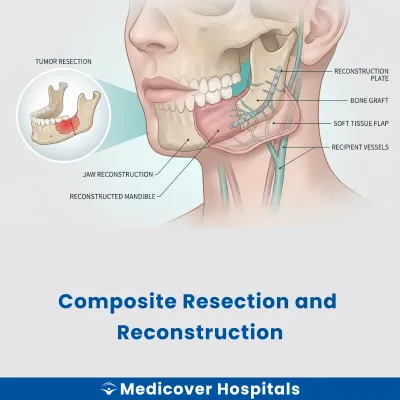
Composite Resection and Reconstruction is a surgical procedure involving the removal (resection) and rebuilding (reconstruction) of complex structures in the head and neck region. This may include parts of the jaw, tongue, or throat. The procedure aims to remove cancerous tissues while restoring function and appearance.
This surgery is often necessary for treating head and neck cancers. Conditions like oral cancer, throat cancer, or advanced skin cancers may require this intervention. If left untreated, these conditions can lead to severe complications, including difficulty in speaking, eating, or breathing. Modern surgical approaches include microvascular free flap reconstruction and 3D printing technology for precise reconstruction. These techniques help in achieving better functional and aesthetic outcomes.
Composite Resection and Reconstruction Doctors Near You
Discover skilled ENT specialists for composite resection and reconstruction at Medicover Hospitals across India. Select your city and book a consultation to address your health needs effectively.
Why Choose Medicover Hospitals for Composite Resection and Reconstruction?
Get a second opinion from trusted experts and makeconfident, informed decisions.
 Get Second Opinion
Complete Guide To Composite Resection And Reconstruction
Everything you need to know about the procedure, preparation, and recovery
Composite Resection and Reconstruction Surgery Indications
Doctors recommend composite resection and reconstruction surgery for complex head and neck conditions. This procedure is often necessary when less invasive treatments are ineffective.
Advanced Oral Cavity Tumours
Patients may experience persistent mouth sores, difficulty swallowing, or unexplained bleeding. Imaging and biopsy Scan often reveal large or invasive tumours. Surgery is suggested when radiation or chemotherapy alone is insufficient.
Recurrent Oral Cancer
Symptoms include pain, swelling, or new lesions in previously treated areas. Recurrence is confirmed through imaging and biopsy. Surgery is considered when previous treatments have failed to control the cancer.
Mandibular Invasion by Tumour
Patients may report jaw pain or difficulty chewing. CT or MRI scans show tumour infiltration into the jawbone. Surgery becomes necessary when the tumour compromises the bone structure.
Complex Facial Trauma
Severe facial injuries can lead to deformity or functional impairment. X-rays or CT scans reveal extensive damage. Surgery is recommended when conservative methods cannot restore function or appearance.
Osteoradionecrosis
Symptoms include jaw pain, exposed bone, or infection post-radiation therapy. Imaging shows bone damage and necrosis. Surgery is needed when hyperbaric oxygen therapy and medications do not heal the tissue.
How to Prepare for Composite Resection and Reconstruction?
Proper preparation is crucial for a successful composite resection and reconstruction. It helps reduce complications and ensures a smoother recovery.
- Medication Review: Stop NSAIDs, anticoagulants, and herbal supplements at least a week before surgery.
- Fasting Guidelines: Fast for at least 8 hours before the procedure to ensure safety during anaesthesia.
- Pre-Surgery Tests: Complete all required blood tests, imaging, and other evaluations as advised by your doctor.
- Clothing: Wear loose, comfortable clothing on the day of surgery for ease of movement post-operation.
- Transportation: Arrange for someone to drive you home after the procedure, as you will not be able to drive yourself.
- Medication List: Bring a list of all medications you take, including dosages, to the hospital.
- Smoking and Alcohol: Avoid smoking and alcohol for at least 48 hours before surgery to aid recovery.
- Pre-Surgery Instructions: Follow any specific instructions given by your surgeon, such as using antiseptic washes.
Composite Resection and Reconstruction Surgery (Step-by-Step)
Overview: This procedure is performed by ENT specialists. It typically lasts 4-6 hours and is done under general anaesthesia.
- Preparation: The patient is placed under general anaesthesia. Vital signs are monitored closely.
- Incision: A surgical incision of 1-2 cm is made in the affected area. This allows access to the diseased tissue.
- Tissue Resection: Using instruments like a harmonic scalpel or curette, the surgeon removes the affected tissue. This step is crucial for eliminating the disease.
- Reconstruction: The surgeon reconstructs the area using grafts or flaps. This restores function and appearance.
- Closure: The incision is closed with sutures or staples. Care is taken to ensure proper healing.
- Recovery: The patient is moved to a recovery room. Monitoring continues as anaesthesia wears off.
- Post-Operative Care: Pain management and wound care instructions are provided. Follow-up appointments are scheduled.
Who Performs Composite Resection and Reconstruction Surgery?
This surgery is performed by ENT specialists. They are trained in managing conditions of the ear, nose, and throat. Their expertise ensures precise execution of both resection and reconstruction phases.
Recovery After Composite Resection and Reconstruction Surgery
Recovery from composite resection and reconstruction surgery is a gradual process. It involves physical healing and adapting to changes. Follow your doctor's advice for a smooth recovery.
Day 1-3:
- Expect some swelling and discomfort. Pain management will be provided.
- Rest is crucial. Avoid any strenuous activity.
- Start with a liquid diet. Include soups and broths.
Day 4-7:
- Swelling may begin to reduce. Continue with prescribed medications.
- Introduce soft foods like curd, dal-rice, and khichdi.
- Gentle movements are encouraged, but avoid bending or lifting.
Day 8-14:
- Stitches may be removed if applicable. Follow-up appointments are important.
- Gradually increase activity levels. Short walks can be beneficial.
- Continue with a soft diet. Moong dal and soft-cooked vegetables are good options.
Phase 3 (Week 3-6):
- Most swelling should subside. Energy levels may improve.
- Resume light activities. Avoid heavy lifting or intense exercise.
- Return to work or school may be possible, depending on recovery.
When to Seek Urgent Help:
- Persistent or worsening pain.
- Signs of infection: fever, redness, or pus at the surgical site.
- Difficulty breathing or swallowing.
- Unusual swelling or bleeding.
Benefits of Composite Resection and Reconstruction Surgery
Composite resection and reconstruction surgery is a vital procedure for treating complex head and neck conditions.
- Improved Functionality: Restores essential functions like speech and swallowing.
- Enhanced Aesthetics: Aims to maintain or improve facial appearance post-surgery.
- Comprehensive Treatment: Addresses both tumour removal and reconstruction in one procedure.
- Reduced Recurrence Risk: Helps in thorough removal of cancerous tissues.
Risks and Complications of Composite Resection and Reconstruction Surgery
While beneficial, this surgery carries certain risks and potential complications.
- Common: Infection at the surgical site.
- Common: Bleeding during or after the procedure.
- Common: Swelling and bruising around the operated area.
- Rare: Nerve damage leading to facial weakness.
- Rare: Graft or flap failure requiring additional surgery.
- Rare: Difficulty in breathing or swallowing post-surgery.
Cost of Composite Resection and Reconstruction Surgery
The cost of Composite Resection and Reconstruction Surgery at Medicover Hospitals varies depending on the ward category chosen. Prices range from Rs. 2500 to Rs. 299000 across different ward types. We offer transparent pricing and support for insurance and TPA, including CGHS, ESI, and major TPAs. Cashless facilities are also available for your convenience. Please contact the hospital for the latest insurance panel details as these may change periodically.
Frequently Asked Questions
1. How much does Composite Resection and Reconstruction surgery cost at Medicover Hospitals?
The cost for Composite Resection and Reconstruction surgery at Medicover Hospitals ranges from Rs. 2500 to Rs. 299000, depending on the specifics of the case.
2. Is Composite Resection and Reconstruction surgery covered under health insurance at Medicover?
Yes, it is typically covered by CGHS, ESI, and major TPAs for cashless treatment. Please contact the hospital for current panel details.
3. Will I need a feeding tube after oral cancer resection?
A feeding tube may be necessary temporarily after oral cancer resection to ensure proper nutrition during recovery.
4. Can I speak normally after laryngeal reconstruction?
Speech may be affected initially after laryngeal reconstruction, but therapy can help improve communication over time.
5. How soon can I eat solid foods after jaw reconstruction?
You may start with soft foods like dal-rice and khichdi after a few weeks, as advised by your doctor.
6. Will I have facial swelling after maxillofacial surgery?
Facial swelling is common after maxillofacial surgery and usually subsides within a few weeks with proper care.
7. Can I return to work after nasal reconstruction?
Returning to work after nasal reconstruction depends on the extent of surgery, but most patients can resume light activities in a few weeks.


