 Call
Call Patient Reports
Closure of Loop Colostomy Surgery Hospital with Advanced Care
Closure of loop colostomy at Medicover Hospitals is performed by skilled general surgeons using advanced laparoscopic techniques. Our team, with qualifications like MS, DNB, and MCh, ensures precise surgical intervention. This approach often results in smaller incisions and reduced recovery time for patients.
Expert Surgeons
Yearly Surgeries
Patient Satisfaction
What is Closure of Loop Colostomy?
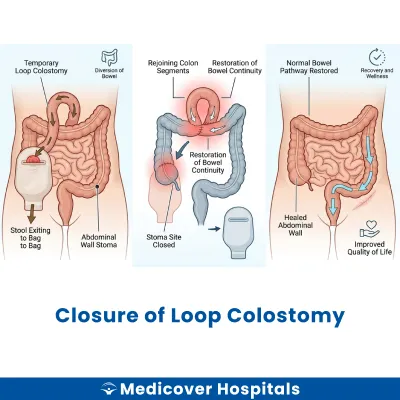
Closure of loop colostomy is a surgical procedure to reverse a loop colostomy. A colostomy involves the large intestine (colon) being diverted through an opening in the abdominal wall. In a loop colostomy, a loop of the colon is brought to the surface. Closure involves reconnecting the colon to restore normal bowel function.
This surgery is needed when the underlying condition that required the colostomy has healed. Conditions like bowel obstruction, injury, or disease may lead to a colostomy. If untreated, it can affect quality of life and digestion. Modern surgical approaches include laparoscopic techniques. These methods are minimally invasive, promoting faster recovery and less pain.
Closure of Loop Colostomy Doctors Near You
Discover skilled general surgeons for closure of loop colostomy at Medicover Hospitals across India. Select your city and book a consultation to address your healthcare needs efficiently.
Why Choose Medicover Hospitals for Closure of Loop Colostomy?
Get a second opinion from trusted experts and makeconfident, informed decisions.
 Get Second Opinion
Complete Guide To Closure Of Loop Colostomy
Everything you need to know about the procedure, preparation, and recovery
Closure of Loop Colostomy Surgery Indications
Doctors recommend closure of loop colostomy when the underlying condition that necessitated the colostomy has been resolved. This procedure is considered when the patient is ready to restore normal bowel function.
Resolution of Initial Condition
Patients who had a loop colostomy due to bowel obstruction or perforation may experience relief from initial symptoms like abdominal pain and bloating. Imaging and tests show normal bowel function. When conservative treatments have stabilized the condition, surgery is considered to restore bowel continuity.
Improved Nutritional Status
Patients may initially suffer from malnutrition or weight loss. Once nutritional status improves, as evidenced by weight gain and normal lab results, doctors may recommend colostomy closure. This is especially true when dietary interventions have been successful.
Absence of Infection
Signs of infection such as fever, redness, or discharge around the stoma may initially prevent closure. Once these symptoms resolve and lab tests confirm no infection, surgery becomes an option.
Stable Medical Condition
Patients with unstable conditions may experience fluctuating vital signs or lab results. When these stabilize, and the patient shows consistent health improvement, doctors may suggest closure.
Patient Readiness
Some patients may initially experience anxiety or psychological distress. Once they are mentally prepared and express a desire to proceed, closure is considered. This readiness is often assessed through patient consultations.
How to Prepare for Closure of loop colostomy?
Proper preparation is crucial for a successful closure of loop colostomy. It ensures a smooth procedure and aids in recovery. Here's how you can prepare:
- Medication Review: Stop NSAIDs, anticoagulants, and herbal supplements as advised by your doctor.
- Fasting: Fast for at least 6-8 hours before the surgery. This is important for anaesthesia safety.
- Bowel Preparation: Follow the specific bowel prep instructions given by your healthcare provider.
- Clothing: Wear loose, comfortable clothing on the day of the surgery to ease movement post-procedure.
- Transport: Arrange for someone to drive you home after the surgery, as you may feel drowsy.
- Medication List: Bring a list of your current medications, including dosages, to the hospital.
- Hydration: Stay well-hydrated before the fasting period begins, unless otherwise instructed.
- Smoking and Alcohol: Avoid smoking and alcohol at least 24 hours before the procedure.
Closure of loop colostomy Surgery (Step-by-Step)
This procedure is performed by surgeons. It typically lasts 1-2 hours and is done under general anaesthesia.
- Preparation: The patient is positioned on the operating table. General anaesthesia is administered to ensure the patient is asleep and pain-free.
- Incision: A small incision, usually 1-2 cm, is made around the stoma site. This allows access to the colostomy loop.
- Dissection: The surgeon uses a scalpel and forceps to carefully dissect and mobilise the bowel segments. This step separates the loop from surrounding tissues.
- Anastomosis: The two ends of the bowel are reconnected. This is done using sutures or staples, ensuring a secure and leak-proof connection.
- Closure: The incision is closed with sutures or surgical staples. The area is then cleaned and dressed with sterile bandages.
- Recovery: The patient is moved to the recovery room. Vital signs are monitored as the patient wakes up from anaesthesia.
- Post-Operative Care: Pain management and dietary instructions are provided. The patient is advised on how to care for the surgical site.
Who Performs Closure of loop colostomy Surgery?
This surgery is performed by general surgeons or colorectal surgeons. These specialists have expertise in bowel surgeries and are skilled in performing colostomy closures. They ensure the procedure is done safely and effectively.
Recovery After Closure of loop colostomy Surgery
Recovery from closure of loop colostomy surgery involves gradual healing and adjustment. Patients can expect to stay in the hospital for a few days post-surgery. It's essential to follow medical advice for a smooth recovery.
Day 1-3:
- Hospital stay is likely. Medical staff will monitor vital signs and manage pain.
- Start with clear liquids like soups and gradually introduce soft foods.
- Rest is crucial. Avoid any strenuous activities.
Day 4-7:
- Transition to a soft diet including curd, dal-rice, and khichdi.
- Continue to avoid heavy lifting or intense physical activities.
- Short walks are encouraged to improve circulation.
Day 8-14:
- Stitches or staples may be removed if healing is adequate.
- Introduce more solid foods like moong dal and soft vegetables.
- Gradually increase activity levels but avoid strenuous exercise.
Phase 3 (Week 3-4):
- Most patients can resume work or school, depending on recovery progress.
- Continue with a balanced diet and stay hydrated.
- Follow up with your doctor to ensure proper healing.
When to Seek Urgent Help:
- Severe abdominal pain or swelling.
- Fever over 100.4?F (38?C).
- Persistent nausea or vomiting.
- Signs of infection at the surgical site, such as redness or discharge.
- Changes in bowel habits or inability to pass stool.
If you experience any of these symptoms, contact your healthcare provider immediately.
Benefits of Closure of loop colostomy Surgery
Closure of loop colostomy surgery is performed to restore normal bowel function. It offers several benefits for patients.
- Restored Bowel Function: Allows the patient to pass stools normally through the rectum.
- Improved Quality of Life: Reduces the need for colostomy care and enhances daily living.
- Reduced Risk of Complications: Eliminates potential issues associated with a stoma, such as skin irritation.
- Enhanced Comfort: Removes the physical and psychological discomfort of having a stoma.
Risks and Complications of Closure of loop colostomy Surgery
While generally safe, closure of loop colostomy surgery carries certain risks and complications. It is important to be aware of these possibilities.
- Common - Infection: Risk of infection at the surgical site.
- Common - Bowel Obstruction: Potential for bowel blockage post-surgery.
- Rare - Anastomotic Leak: Leakage at the site where the bowel is reconnected.
- Rare - Bleeding: Risk of bleeding during or after the procedure.
- Rare - Hernia: Development of a hernia at the incision site.
Cost of Closure of loop colostomy Surgery
The cost of Closure of loop colostomy Surgery at Medicover Hospitals varies depending on the ward category chosen. Prices range from Rs.46980 to Rs.66760 across different ward types. This ensures that patients can select a suitable option based on their needs and budget.
Medicover Hospitals offers transparent pricing with support for insurance and TPA, including CGHS, ESI, and major TPAs. A cashless facility is also available for added convenience. Please contact the hospital for the latest insurance panel details as these may change periodically.
Frequently Asked Questions
1. How much does Closure of loop colostomy surgery cost at Medicover Hospitals?
The cost for Closure of loop colostomy surgery at Medicover Hospitals ranges from Rs.46,980 to Rs.66,760, depending on the room type and other factors.
2. Is Closure of loop colostomy surgery covered under health insurance at Medicover?
Closure of loop colostomy surgery is often covered by CGHS, ESI, and major TPAs. Please contact the hospital for current panel details.
3. Will I need a special diet after colostomy closure?
Post-surgery, a soft diet including curd, dal-rice, and khichdi is recommended. Gradually reintroduce regular foods as advised by your doctor.
4. Can I resume normal activities after colostomy closure?
You can gradually return to normal activities within 4-6 weeks. Avoid heavy lifting and strenuous exercises until your doctor gives the go-ahead.
5. What complications can occur after colostomy closure?
Complications may include bowel obstruction or infection. Regular follow-ups with your healthcare provider can help monitor and manage these risks.
6. Will I experience changes in bowel habits post-surgery?
Yes, you may experience changes like increased frequency or loose stools initially. These usually settle over time with dietary adjustments and medical advice.
7. How soon can I travel after colostomy closure?
Travel is generally safe after 4-6 weeks, once recovery is stable. Always consult your doctor before planning long trips.
8. When is colostomy closure done?
Colostomy closure is usually done after 6–12 weeks, once the underlying condition has healed and the patient is stable. The exact timing depends on recovery and absence of infection or complications.
9. Can a loop colostomy be reversed?
Yes, a Loop Colostomy can usually be reversed successfully. It is often created as a temporary measure and closed once healing is complete.


