 Call
Call Patient Reports
Best Hospital for Closed Intramedullary Nailing for Long Bone Fracture Surgery
Closed intramedullary nailing for long bone fractures at Medicover Hospitals is performed using minimally invasive techniques. Our orthopaedic surgeons, with qualifications like MS and DNB, ensure precise alignment. This approach results in smaller incisions and reduced blood loss, promoting quicker recovery.
Expert Surgeons
Yearly Surgeries
Patient Satisfaction
What is Closed Intramedullary Nailing for Long Bone Fracture?
Closed intramedullary nailing is a surgical procedure used to treat fractures of long bones like the femur or tibia. In this method, a metal rod (nail) is inserted into the medullary cavity (central canal) of the bone without opening the fracture site. This helps in stabilizing the bone and promoting healing. The procedure is minimally invasive, as it requires only small incisions.
This surgery is necessary when a long bone fracture occurs due to trauma or accidents. If left untreated, such fractures can lead to improper healing, deformity, or loss of function. Closed intramedullary nailing is often chosen for its effectiveness in aligning and stabilizing the bone. Modern surgical approaches include image-guided techniques and minimally invasive methods to ensure precise placement of the nail.
Closed Intramedullary Nailing for Long Bone Fracture Doctors Near You
Discover skilled orthopedics for closed intramedullary nailing of long bone fractures at Medicover Hospitals across India. Choose your city and book a consultation to begin your recovery journey.
Why Choose Medicover Hospitals for Closed Intramedullary Nailing for Long Bone Fracture?
Get a second opinion from trusted experts and makeconfident, informed decisions.
 Get Second Opinion
Complete Guide To Closed Intramedullary Nailing For Long Bone Fracture
Everything you need to know about the procedure, preparation, and recovery
Closed Intramedullary Nailing for Long Bone Fracture Procedure Indications
Doctors recommend closed intramedullary nailing for stabilising long bone fractures. This procedure is often chosen when fractures are complex or when other treatments have not been successful.
Severe Fracture Displacement
Patients may experience intense pain and inability to bear weight. X-rays or CT scans show significant misalignment of the bone fragments. When realignment through casting or bracing is not possible, surgery is considered.
Open Fractures
These fractures involve a break in the skin, causing visible bone and potential infection. Immediate imaging confirms the severity and risk of complications. Surgery is often necessary to prevent infection and promote healing.
Non-union of Fractures
Patients report persistent pain and lack of healing over months. X-rays reveal no progress in bone healing. When conservative methods like immobilisation and physiotherapy fail, surgical intervention is required.
Pathological Fractures
These occur with minimal trauma, often due to weakened bones from conditions like osteoporosis. Imaging shows fractures without significant injury history. Surgery is needed when bones are too weak for traditional healing.
Multiple Fractures
Patients have multiple fractures in the same bone, causing severe pain and instability. Imaging shows complex fracture patterns. When splinting or casting cannot provide stability, surgery becomes necessary.
How to Prepare for Closed Intramedullary Nailing for Long Bone Fracture?
Proper preparation is crucial for a smooth surgery and recovery. It helps minimise risks and ensures the best possible outcome for the procedure.
- Medication Review: Stop NSAIDs, anticoagulants, and herbal supplements as advised by your doctor.
- Fasting: Do not eat or drink anything for at least 8 hours before the surgery to prepare for anaesthesia.
- Pre-surgery Tests: Complete any blood tests, X-rays, or other investigations as instructed by your healthcare provider.
- Personal Items: Wear loose, comfortable clothing on the day of the surgery. It helps in easy dressing post-surgery.
- Transportation: Arrange for someone to drive you home after the procedure as you may feel drowsy post-anaesthesia.
- Medication List: Bring a list of your current medications, including dosages, to the hospital.
- Smoking and Alcohol: Avoid smoking and alcohol for at least 24 hours before the surgery to reduce complications.
- Hygiene: Take a shower and clean the surgical area as advised to reduce infection risk.
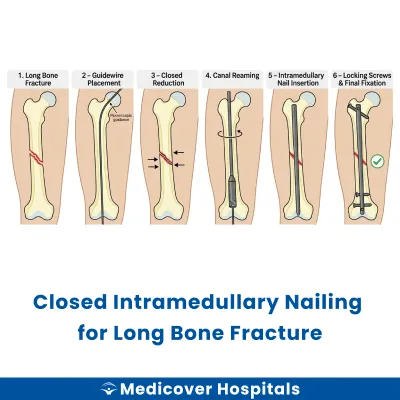
Closed Intramedullary Nailing for Long Bone Fracture Procedure (Step-by-Step)
This procedure is performed by orthopaedic surgeons. It typically lasts 1-2 hours. General or regional anaesthesia is used to ensure the patient is comfortable and pain-free.
- Preparation: The patient is positioned on the operating table. The surgical area is cleaned and sterilised.
- Incision: A small incision of about 1-2 cm is made near the fracture site. This allows access to the bone.
- Guide Wire Insertion: A guide wire is inserted through the incision into the bone canal. This wire helps in aligning the nail.
- Reaming: A reamer is used to widen the bone canal. This step prepares the bone for the nail insertion.
- Nail Insertion: An intramedullary nail is inserted over the guide wire. The nail stabilises the fracture internally.
- Locking Screws Placement: Screws are placed through the nail to lock it in position. This ensures the bone fragments are securely held.
- Closure: The incision is closed with sutures or staples. A dressing is applied to protect the wound.
Who Performs Closed Intramedullary Nailing for Long Bone Fracture Procedure?
This procedure is performed by orthopaedic surgeons. They specialise in diagnosing and treating bone and joint conditions. Their expertise ensures proper alignment and healing of fractures.
Recovery After Closed Intramedullary Nailing for Long Bone Fracture Procedure
Recovery from closed intramedullary nailing involves gradual healing and rehabilitation. Expect some discomfort initially, but it should decrease over time. Follow your doctor's instructions for a smooth recovery.
Day 1-3:
- Rest is crucial. Keep the affected limb elevated to reduce swelling.
- Consume light meals like curd, dal-rice, and soups to aid digestion.
- Begin gentle movements as advised by your doctor to prevent stiffness.
Day 4-7:
- Continue with prescribed pain management and physiotherapy exercises.
- Introduce soft foods like khichdi and moong dal to your diet for energy.
- Avoid putting weight on the affected limb unless advised by your doctor.
Week 2-4:
- Gradually increase activity levels under medical guidance.
- Incorporate more variety in meals, focusing on protein-rich foods for healing.
- Begin partial weight-bearing activities if permitted by your healthcare provider.
Phase 1-3 Months:
- Engage in regular physiotherapy to regain strength and mobility.
- Return to work or school may be possible, depending on the nature of activities.
- Avoid high-impact activities until fully healed.
When to Seek Urgent Help
- Severe pain unrelieved by medication.
- Signs of infection: redness, warmth, or discharge at the surgical site.
- Numbness or tingling in the affected limb.
- Sudden swelling or inability to move the limb.
Benefits of Closed Intramedullary Nailing for Long Bone Fracture Procedure
Closed intramedullary nailing is a widely used technique for treating long bone fractures. It offers several advantages for patients.
- Minimally Invasive: The procedure involves smaller incisions, leading to reduced tissue damage.
- Faster Recovery: Patients often experience quicker rehabilitation compared to other surgical methods.
- Enhanced Stability: The nail provides strong internal support, promoting effective bone healing.
- Reduced Infection Risk: With less exposure of the fracture site, the risk of infection is lowered.
- Early Mobilisation: Patients can begin weight-bearing activities sooner, aiding in overall recovery.
Risks and Complications of Closed Intramedullary Nailing for Long Bone Fracture Procedure
While generally safe, closed intramedullary nailing does carry some risks and potential complications.
- Pain or discomfort at the site of the nail insertion.
- Swelling or bruising around the surgical area.
- Infection at the incision site or deeper within the bone.
- Nerve or blood vessel damage during the procedure.
- Non-union or delayed healing of the fracture.
- Hardware irritation or loosening over time.
Common Risk:
Rare Complications:
Cost of Closed Intramedullary Nailing for Long Bone Fracture Procedure
The cost for the Closed intramedullary nailing for long bone fracture procedure at Medicover Hospitals ranges from Rs.50,000 to Rs.2,00,000 depending on the ward category chosen. The pricing is transparent and varies by the type of accommodation selected.
We offer insurance and TPA support, accepting CGHS, ESI, and major TPAs, with a cashless facility available for your convenience. Please contact the hospital for the latest insurance panel details as these may change periodically.
Frequently Asked Questions
1. How much does Closed intramedullary nailing for long bone fracture procedure cost at Medicover Hospitals?
The cost for Closed intramedullary nailing for long bone fracture procedure ranges from Rs.50,000 to Rs.2,00,000 across Medicover Hospitals, depending on the type of room and care.
2. Is Closed intramedullary nailing for long bone fracture procedure covered under health insurance at Medicover?
Yes, it is often covered under CGHS, ESI, and major TPAs with cashless options. Please contact the hospital for current panel details.
3. Can I walk immediately after the procedure?
Walking is usually encouraged soon after the procedure with assistance. Full weight-bearing might take a few weeks depending on the fracture.
4. Will I need physiotherapy after the procedure?
Yes, physiotherapy is often recommended to regain strength and mobility. It plays a crucial role in the recovery of long bone fractures.
5. Can I drive after Closed intramedullary nailing?
Driving is generally not advised until you have adequate control and strength. Your doctor will guide you based on your recovery progress.
6. What complications should I watch for post-procedure?
Watch for signs of infection like redness or swelling at the incision site. Report any unusual pain or fever to your doctor immediately.
7. What diet should I follow after the procedure?
A balanced diet with foods like curd, dal-rice, and khichdi is recommended. These help in healing and provide necessary nutrients.


