 Call
Call Patient Reports
AC Joint Reconstruction and Stabilization with Acromioplasty Surgery by Expert Orthopedics
At Medicover Hospitals, our orthopaedic team, with qualifications like MS and DNB, performs open AC Joint Reconstruction and Stabilization with Acromioplasty. This procedure addresses joint instability and pain. Patients benefit from smaller incisions, leading to reduced blood loss and quicker recovery.
Expert Surgeons
Yearly Surgeries
Patient Satisfaction
What is AC Joint Reconstruction and Stabilization With Acromioplasty?
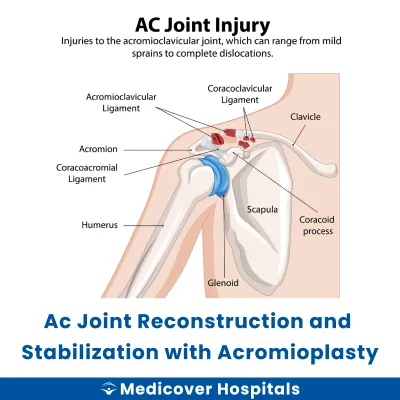
AC Joint Reconstruction and Stabilization with Acromioplasty is a surgical procedure involving the shoulder. The acromioclavicular (AC) joint, where the collarbone meets the shoulder blade, is reconstructed and stabilized. Acromioplasty involves reshaping the acromion (a bony part of the shoulder blade) to relieve pressure on the rotator cuff. This helps restore normal function and reduces pain.
This surgery is needed for conditions like severe AC joint dislocation or arthritis. Such issues can cause significant pain and limit shoulder movement. If left untreated, they may lead to chronic pain and dysfunction. Modern surgical approaches include minimally invasive arthroscopic techniques. These methods aim to reduce recovery time and improve outcomes.
AC Joint Reconstruction and Stabilization With Acromioplasty Doctors Near You
Find experienced orthopedics for AC joint reconstruction and stabilization with acromioplasty at Medicover Hospitals across India. Choose your city and book a consultation today for expert care.
Why Choose Medicover Hospitals for AC Joint Reconstruction and Stabilization With Acromioplasty?
Get a second opinion from trusted experts and makeconfident, informed decisions.
 Get Second Opinion
Complete Guide To Ac Joint Reconstruction And Stabilization With Acromioplasty
Everything you need to know about the procedure, preparation, and recovery
AC Joint Reconstruction and Stabilization with Acromioplasty Surgery Indications
Doctors recommend AC Joint Reconstruction and Stabilization with Acromioplasty when conservative treatments fail to relieve symptoms. This procedure is often necessary to restore shoulder function and alleviate pain.
Chronic AC Joint Dislocation
Patients experience persistent shoulder instability and pain, especially when lifting the arm. Doctors find abnormal joint movement on physical examination and confirm dislocation through imaging. Surgery is advised when physical therapy and bracing do not improve stability.
Severe AC Joint Arthritis
Patients report constant shoulder pain and limited range of motion. X-rays reveal joint space narrowing and bone spurs. When medications and injections fail to provide relief, surgery becomes necessary.
AC Joint Separation
Patients feel a visible bump on the shoulder and experience pain during arm movement. Physical exams show misalignment, confirmed by X-rays. Surgery is considered when conservative measures like rest and physiotherapy are ineffective.
Failed Previous Shoulder Surgery
Patients continue to have pain and dysfunction after prior shoulder procedures. Imaging may show incomplete healing or persistent joint issues. Surgery is recommended when revision is needed to restore function.
Impingement Syndrome with AC Joint Involvement
Patients suffer from shoulder pain and difficulty lifting the arm. Tests reveal tendon impingement and AC joint abnormalities. When non-surgical treatments do not alleviate symptoms, surgery is indicated.
How to Prepare for AC Joint Reconstruction and Stabilization with Acromioplasty?
Proper preparation is crucial for a smooth surgery and recovery. It helps minimize risks and ensures optimal outcomes for AC Joint Reconstruction and Stabilization with Acromioplasty.
- Medication Review: Stop NSAIDs, anticoagulants, and herbal supplements 1-2 weeks before surgery.
- Fasting Guidelines: Do not eat or drink anything for at least 8 hours before surgery to prepare for anaesthesia.
- Pre-Surgery Exercises: Perform shoulder mobility exercises as advised by your physiotherapist.
- Clothing Choice: Wear loose, comfortable clothing on the day of surgery for easy dressing post-operation.
- Transportation: Arrange for someone to drive you home after the procedure, as you will not be able to drive.
- Medication List: Bring a list of all medications you are currently taking, including dosages, to the hospital.
- Smoking and Alcohol: Avoid smoking and alcohol for at least 24 hours before surgery to reduce complications.
- Pre-Admission Testing: Complete any required blood tests or imaging studies as instructed by your healthcare provider.
AC Joint Reconstruction and Stabilization with Acromioplasty Surgery (Step-by-Step)
Overview: This procedure is performed by orthopaedic surgeons. It typically lasts 1-2 hours. General anaesthesia is commonly used to ensure the patient is asleep and pain-free.
- Incision: A small incision, about 3-5 cm, is made over the shoulder to access the AC joint.
- Joint Assessment: The surgeon examines the joint using instruments like a curette to remove any damaged tissue.
- Acromioplasty: A harmonic scalpel is used to shave down the acromion, relieving pressure on the rotator cuff.
- Reconstruction: The damaged ligaments are reconstructed using sutures or grafts to stabilize the joint.
- Stabilization: A coblation wand may be used to further stabilize the joint by tightening the surrounding tissues.
- Closure: The incision is closed with sutures or staples, and a sterile bandage is applied.
- Recovery: The patient is moved to a recovery area to wake up from anaesthesia, experiencing some soreness and swelling.
Who Performs AC Joint Reconstruction and Stabilization with Acromioplasty Surgery?
This surgery is performed by orthopaedic surgeons who specialise in shoulder procedures. They have expertise in managing joint injuries and use precise techniques to restore function and stability to the shoulder.
Recovery After AC Joint Reconstruction and Stabilization with Acromioplasty Surgery
Recovery from AC Joint Reconstruction and Stabilization with Acromioplasty Surgery involves gradual healing and rehabilitation. Patients can expect a structured recovery process, focusing on pain management, mobility, and strengthening exercises.
Day 1-3:
- Rest and limit arm movement. Use a sling for support.
- Apply ice packs to reduce swelling.
- Consume soft, easy-to-digest foods like curd, dal-rice, and soups.
Day 4-7:
- Begin gentle pendulum exercises as advised by your doctor.
- Continue with a balanced diet, including moong dal and khichdi for protein and energy.
- Gradually increase arm movements within comfort.
Week 2-4:
- Start physical therapy to improve range of motion.
- Introduce light activities but avoid lifting heavy objects.
- Return to work or school may be possible, depending on the nature of your activities.
Phase 1 (Week 5-8):
- Focus on strengthening exercises under supervision.
- Resume normal diet, ensuring adequate protein and calcium intake.
- Gradually increase daily activities but avoid strenuous tasks.
Phase 2 (Week 9-12):
- Continue strengthening and flexibility exercises.
- Most daily activities can be resumed, but consult your doctor before engaging in sports.
When to Seek Urgent Help
- Severe pain not relieved by medication.
- Signs of infection such as fever, redness, or discharge at the surgical site.
- Numbness or tingling in the arm.
If you experience any of these symptoms, contact your healthcare provider immediately.
Benefits of AC Joint Reconstruction and Stabilization with Acromioplasty Surgery
This procedure aims to restore shoulder function and alleviate discomfort. It can significantly improve daily activities.
- Pain Relief: Reduces shoulder pain by addressing joint instability.
- Improved Mobility: Enhances range of motion in the shoulder.
- Joint Stability: Strengthens the AC joint, preventing future dislocations.
- Enhanced Functionality: Allows for better performance in physical activities.
Risks and Complications of AC Joint Reconstruction and Stabilization with Acromioplasty Surgery
While generally safe, this surgery carries some risks. Understanding them helps in making informed decisions.
Common Risks
- Infection at the surgical site.
- Stiffness or reduced shoulder movement post-surgery.
Rare Risks
- Nerve damage leading to numbness or weakness.
- Blood clots forming in the veins.
- Recurrence of joint instability or dislocation.
- Allergic reaction to anaesthesia.
Cost of AC Joint Reconstruction and Stabilization with Acromioplasty Surgery
The cost of AC Joint Reconstruction and Stabilization with Acromioplasty Surgery at Medicover Hospitals ranges from ₹1,50,000 to ₹5,00,000. The price varies depending on the ward category chosen. We offer transparent pricing and support for insurance and TPA, including CGHS, ESI, and major TPAs. A cashless facility is also available for your convenience. Please contact the hospital for the latest insurance panel details as these may change periodically.
Frequently Asked Questions
1. How much does AC Joint Reconstruction and Stabilization with Acromioplasty surgery cost at Medicover Hospitals?
The cost for AC Joint Reconstruction and Stabilization with Acromioplasty surgery at Medicover Hospitals ranges from ₹1,50,000 to ₹5,00,000
2. Is AC Joint Reconstruction and Stabilization with Acromioplasty surgery covered under health insurance at Medicover?
Yes, it is often covered under CGHS, ESI, and major TPAs. Please contact the hospital for current panel details.
3. Will I regain full shoulder movement after surgery?
Post-surgery, most patients regain significant shoulder movement. Physical therapy is crucial for optimal recovery and restoring full range of motion.
4. Can I lift heavy objects after AC joint surgery?
Lifting heavy objects is usually restricted for several weeks. Consult your doctor for specific guidelines based on your recovery progress.
5. Will I experience shoulder pain after surgery?
Some pain and discomfort are common after surgery. Pain management and physiotherapy help alleviate symptoms and improve recovery.
6. Can I play sports after AC joint surgery?
Returning to sports is possible after rehabilitation. Your doctor will advise when it's safe based on your healing and strength.
7. What foods aid recovery after AC joint surgery?
A balanced diet with curd, dal-rice, and khichdi supports healing. Nutrient-rich foods can boost recovery and improve overall health.


