 Call
Call Patient Reports
- Cardiology 84
- Dermatology 45
- Endocrinology 33
- ENT 16
- Fertility 190
- Gastroenterology 78
- General-Medicine 81
- Gynecology 80
- Hematology 19
- Infectious-Diseases 33
- Neurology 52
- Oncology 34
- Ophthalmology 23
- Orthopedics 69
- Pediatrics 31
- Procedure 23
- Public-Health 144
- Pulmonology 59
- Radiology 8
- Urology 68
- Wellness 161
- Woman-and-child 77

- 1758
- 3.7 Minute
Written by Medicover Team and Medically Reviewed by Dr Hareesha Babu K Senior Consultant Nephrologist & Transplant Physician
Kidney Transplant in Bangalore
Bangalore has become a major destination for renal transplantation because of advanced medical infrastructure, experienced kidney transplant teams, and standardized transplant protocols.
A kidney transplant is the most effective long-term treatment for patients with end-stage kidney disease. Many patients and families search for clear information about kidney transplant cost in Bangalore, eligibility, success rates, and what the procedure involves.
Understanding the costs and process helps you plan treatment confidently and avoid last-minute surprises. This guide explains the kidney transplant surgery cost in Bangalore, what affects pricing, and what you should expect before and after the procedure.
What Is the Kidney Transplant Cost in Bangalore (Bengaluru)?
The kidney transplant cost in Bangalore typically ranges from ₹6,00,000 to ₹11,00,000, depending on the type of transplant, the donor source, hospital facilities, and post-transplant care requirements.
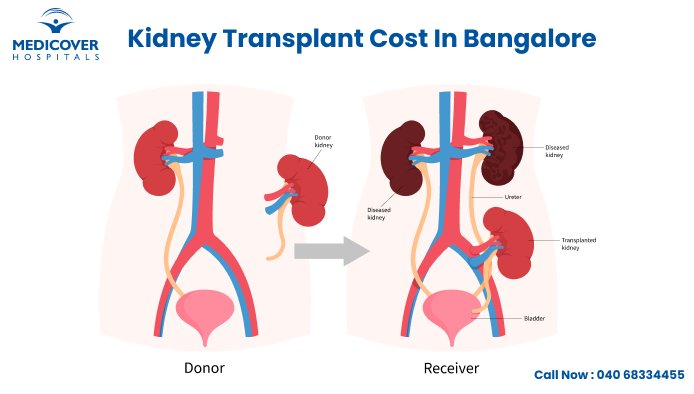
What Is a Kidney Transplant?
A kidney transplant is a surgical procedure in which a healthy kidney from a donor is implanted into a patient whose kidneys are not functioning adequately. The transplanted kidney performs essential functions such as filtering waste, balancing fluids, and regulating electrolytes.
Unlike dialysis, a successful kidney transplant, when proper follow-up care is maintained, allows for a better quality of life, fewer dietary restrictions, and improved long-term survival.
What Are the Types of Kidney Transplant?
There are mainly three types of kidney transplant procedures:
- Living Donor Kidney Transplant: The donor is a healthy relative or compatible individual. This option usually has better outcomes and lower waiting times.
- Deceased Donor Kidney Transplant: The kidney comes from a brain-dead donor. Waiting time can be longer.
- ABO-Incompatible or Swap Transplant: Used when a blood group mismatch exists, involving paired donor exchange or special immunological preparation.
Each type influences the renal transplantation cost in Bangalore.
Get a second opinion from trusted experts and makeconfident, informed decisions.
Get Second OpinionNot sure where to start?
Talk to a patient care advisor — free, confidential, 24/7. We'll match you to the right specialist and book your appointment in minutes.
Current Scenario of Kidney Transplants in India
India performs over 12,000 kidney transplants annually, making it one of the leading countries in kidney transplantation. Living donor transplants account for approximately 85-90% of the procedures.
With increasing awareness, improved legal frameworks, and transplant registries, the success rate and safety of kidney transplants in India continue to improve at major transplant centers.
Who Is Eligible for a Kidney Transplant?
You may be eligible for a kidney transplant if:
- You have end-stage kidney disease or irreversible kidney failure
- You are medically fit for surgery
- You do not have uncontrolled infections or active cancer
- You can adhere to lifelong medications and follow-ups
Eligibility is confirmed after detailed medical, cardiac, and immunological evaluations.
Approximate Kidney Transplant Cost in Bangalore
| Type of Transplant | Approximate Cost Range |
|---|---|
| Living Donor Transplant | ₹5.5 - ₹8.5 lakhs |
| Deceased Donor Transplant | ₹6.5 - ₹10 lakhs |
| ABO-Incompatible Transplant | ₹8 - ₹12 lakhs |
Kidney Transplant Cost in Bangalore vs Other Cities
| City | Average Cost Range |
|---|---|
| Bangalore | ₹6 - ₹11 lakhs |
| Chennai | ₹5 - ₹10 lakhs |
| Hyderabad | ₹5.5 - ₹10.5 lakhs |
| Delhi NCR | ₹6 - ₹14 lakhs |
| Mumbai | ₹6.5 - ₹15 lakhs |
Cost Breakdown of Kidney Transplant in Bangalore
Understanding the cost of a kidney transplant can seem daunting at first. Many people assume the price covers only the surgery itself. In reality, the cost of a kidney transplant involves multiple stages, each playing a crucial role in ensuring the transplant is safe, successful, and sustainable in the long term.
A kidney transplant is not a one-day event. It is a carefully planned medical journey that begins weeks before the surgery and continues long after discharge. Knowing where the costs come from will help you prepare better, both financially and emotionally.
Below is a detailed explanation of what is usually included in the kidney transplant cost.
- Pre-transplant evaluation and diagnostic tests: Before a kidney transplant can be approved, both the recipient and the donor must undergo extensive medical evaluations.
- Donor evaluation and legal clearance: If the transplant involves a living donor, additional assessments are required. These ensure that the donor is healthy and will not face long-term risks after the donation. This step protects both the donor and the recipient and is a crucial part of ethical and legal transplant care.
- Surgical procedure and operating theatre charges: The surgery itself is a significant component of the total cost of a kidney transplant. It involves two parallel surgeries, one for the donor (in the case of a living donor) and another for the recipient. Kidney transplant surgery requires highly trained specialists and a fully equipped setup, which directly impacts the overall cost.
- Hospital stay and inpatient care: After the surgery, both the donor and the recipient require close monitoring. The duration of the hospital stay can vary depending on the recovery rate and medical condition. Care during this period focuses on early detection of rejection, infection prevention, and ensuring stable kidney function.
- Medications and immunosuppressive therapy: One of the long-term costs after a kidney transplant is immunosuppressive medication.
- Post-transplant monitoring and follow-ups: After discharge, regular follow-up visits help ensure that the new kidney is functioning well and that the medications are working as intended.
- Managing complications: While most kidney transplants proceed smoothly, some patients experience complications such as infections, rejection episodes, or medication-related problems. Not every patient will incur these costs, but it is important to be prepared for them as part of comprehensive care.
Kidney Transplant Success Rate in Bangalore
The kidney transplant success rate in Bangalore is considered high and comparable to leading transplant centers across India. Success is typically measured in two ways: short-term graft survival (the kidney functioning well in the first year) and long-term patient survival.
In established transplant hospitals, the one-year kidney transplant success rate is typically above 90-95% when the surgery is well-planned, the donor is carefully evaluated, and post-transplant care is properly followed. Living donor kidney transplants generally show slightly better outcomes than deceased donor transplants because the kidney is transplanted quickly and is healthier.
With the right medical team, patient education, and long-term follow-up, most transplant recipients lead active, independent lives for years or even decades after the surgery.
Why Choose a Kidney Transplant at Medicover Hospitals, Bangalore?
Choosing the right hospital for a kidney transplant is one of the most important decisions you will make. Kidney transplantation is not a single procedure. It is a long journey that requires expertise, coordination, and long-term care.
Medicover Hospitals in Whitefield, Bangalore, offers a comprehensive kidney transplant program that focuses on safety outcomes and patient support at every stage.
Our key strengths include:
- A multidisciplinary transplant team involving nephrologists, transplant surgeons, anesthetists, urologists, and infection specialists
- Structured pre-transplant evaluation for both donor and recipient
- Advanced operating theatres and intensive care support
- Evidence-based immunosuppression protocols
- Dedicated transplant coordinators to guide patients and families
- Long-term follow-up programs focused on graft survival and patient well-being
- Having the track record of Live Renal Transplant for ADPKD in Bangalore and Kidney Transplant Surgery for International Patients
For many patients, having access to coordinated care under one roof reduces stress and improves confidence during an already challenging phase of life.
Factors Affecting the Cost of Your Kidney Transplant in Bangalore
The cost of a kidney transplant in Bangalore is not a fixed amount for every patient. It varies because each transplant journey is unique.
Several medical, surgical, and post-surgical factors together determine the final cost. Understanding these factors helps you plan better and avoid unexpected expenses later.
Type of Kidney Transplant Performed
The type of kidney transplant plays a major role in cost variation.
- Living Donor Kidney Transplant usually costs less because surgery can be planned in advance, and the kidney quality is well assessed.
- Deceased Donor Kidney Transplant may involve higher costs due to emergency admission, longer ICU care, and extended pre-surgery monitoring.
Because the surgical complexity and hospital stay differ, the renal transplantation cost in Bangalore changes accordingly.
Donor Evaluation and Compatibility Testing
Before transplant surgery, both donor and recipient undergo extensive medical testing, including:
- Blood group matching
- HLA tissue typing
- Crossmatch tests
- Infection screening
- Cardiac and general health assessment
Recipient's Overall Health Condition
The recipient's health status significantly impacts the final cost.
Patients with:
- Diabetes
- Heart diseases
- Lung problems
- Long-standing dialysis complications
- Previous surgeries or infections
May require:
- Additional specialist consultations
- Advanced imaging
- Longer ICU monitoring
This can increase hospitalization expenses and overall kidney transplant costs in Bangalore.
Length of Hospital Stay and ICU Care
Not all patients recover at the same pace.
- A smooth recovery may require 10-14 days of hospital stay
- Complications or slow graft function may extend ICU and ward care
Longer stays increase room charges, nursing care, monitoring costs, and medication expenses, directly affecting the renal transplantation cost in Bangalore.
Immunosuppressive Medications
After a kidney transplant, lifelong immunosuppressive medicines are required to prevent kidney rejection.
Costs depend on:
- Type of drugs prescribed
- Brand vs generic medications
- Dosage adjustments based on response
Some patients need stronger or combination therapies, which can slightly increase long-term expenses beyond the initial kidney transplant surgery cost in Bangalore.
Diagnostic Tests and Follow-Up Monitoring
After surgery, frequent tests are needed to ensure the transplanted kidney is functioning well, such as:
- Kidney function tests
- Ultrasound scans
- Drug-level monitoring
- Kidney biopsies
These tests are essential for long-term success and form a necessary part of the kidney transplant cost in Bangalore.
Hospital Infrastructure and Support Services
The level of hospital care also matters.
Hospitals offering:
- Dedicated transplant ICUs
- 24/7 nephrology and urology teams
- Infection-controlled transplant wards
- In-house labs and imaging
May have slightly higher costs, but they provide better safety, faster response, and improved transplant outcomes.
Insurance Coverage and Government Schemes
The final out-of-pocket cost also depends on:
- Health insurance coverage
- Government transplant schemes
- Corporate or employer policies
Some expenses may be partially or fully covered, reducing the personal financial burden of a kidney transplant in Bangalore.
Need More Details about Kidney Transplantation?
If you are looking for clear and reliable information about kidney transplant treatment, speaking directly with experienced specialists can make a real difference. Kidney transplantation involves multiple medical decisions, and having the right guidance will help you confidently understand the process, costs, recovery, and long-term care.
Kidney transplant care is provided by a dedicated team of nephrologists, transplant surgeons, urologists, anesthesiologists, and critical care specialists who work together to plan treatment based on your individual medical needs at Medicover Hospitals in Bangalore. From eligibility assessment to post-transplant follow-up, every step is managed with careful evaluation and patient safety in mind.
If you have any questions about kidney transplant procedures, costs, donor options, or recovery, you can speak with our medical experts for personalized advice. To learn more or to discuss your condition, you can call our hospital or schedule a consultation with the kidney transplant team at Medicover Hospitals.
Disclaimer:
The cost ranges and treatment estimates mentioned on this website are intended for general information purposes only. These figures are indicative and are based on typical clinical scenarios. They should not be considered as a final quote for any procedure or a guarantee of exact cost.
Medicover Hospitals does not ensure the completeness, accuracy or reliability of these estimated costs. Actual costs for treatment may vary depending on the patient's medical condition, diagnostic requirements, type of surgery, surgeon’s assessment, hospital location, room category and any additional services required. Insurance coverage and medical approvals may also affect the final cost.
By using this information, you acknowledge and agree that these estimates are subject to change and should not be relied upon as a confirmed price. For a personalized and accurate cost estimate tailored to your situation, we encourage you to consult our healthcare team or contact us directly for guidance
Conclusion
A kidney transplant can be life-changing, but it requires careful planning, realistic expectations, and long-term commitment. Understanding the cost, success rates, risks, and post-transplant responsibilities helps you make informed decisions.
If you or a loved one is considering kidney transplant surgery, discussing all options openly with a transplant team is the best first step. With proper evaluation and follow-up, kidney transplantation remains one of the most effective treatments for end-stage kidney disease.
Your health is everything - prioritize your well-being today.
Schedule Your AppointmentFrequently Asked Questions
The total cost of a kidney transplant ranges from Rs. 6,00,000 to Rs. 11,00,000, depending on factors such as the type of transplant, hospital infrastructure, surgeon expertise, donor evaluation, and post-transplant medications.
No medical procedure offers a 100% guarantee. However, kidney transplants have high success rates when performed at experienced centers and when patients follow medical advice closely.
Like any major surgery, a kidney transplant carries certain risks, including infection, bleeding, or rejection of the transplanted kidney. That said, with modern surgical techniques, advanced monitoring, and improved medications, kidney transplant risks are well controlled when done at a well-equipped hospital under specialist care.
Kidney transplant cost in private hospitals in Bangalore varies based on hospital facilities, type of transplant, length of hospital stay, and complexity of the case. The cost generally includes surgery charges, ICU care, diagnostics, medications, and follow-up care.
Diagnostic test costs vary depending on the number and type of investigations required for both donor and recipient. These tests typically include blood tests, imaging scans, cardiac evaluation, and infection screening, all of which are essential to ensure transplant safety.
No. Kidney donation in India is strictly regulated by law. Commercial organ donation is illegal, and donors are not paid for donating a kidney. Transplants are permitted only between related donors or approved altruistic donors, following authorization by the committee to ensure ethical practices.
- Cardiology
- Case Studies
- Dermatology
- Endocrinology
- ENT
- Fertility
- Gastroenterology
- General
- General-Medicine
- Gynecology
- Hematology
- Infectious-Diseases
- Medical News
- Neurology
- Oncology
- Ophthalmology
- Orthopedics
- Pediatrics
- Procedure
- Public-Health
- Pulmonology
- Radiology
- Second Opinion
- Urology
- Wellness
- Woman-and-child
Related Blogs
Still have questions? Speak with our experts now!
040-68334455


