 040 68334455
 Chat for Appointment
 Patient Reports / Login
 International Patient Care
- Cardiology 84
- Dermatology 45
- Endocrinology 33
- ENT 16
- Fertility 190
- Gastroenterology 78
- General-Medicine 81
- Gynecology 80
- Hematology 19
- Infectious-Diseases 33
- Neurology 52
- Oncology 34
- Ophthalmology 23
- Orthopedics 69
- Pediatrics 31
- Procedure 23
- Public-Health 144
- Pulmonology 59
- Radiology 8
- Urology 68
- Wellness 161
- Woman-and-child 77
- 1758
- 3.7 Minute
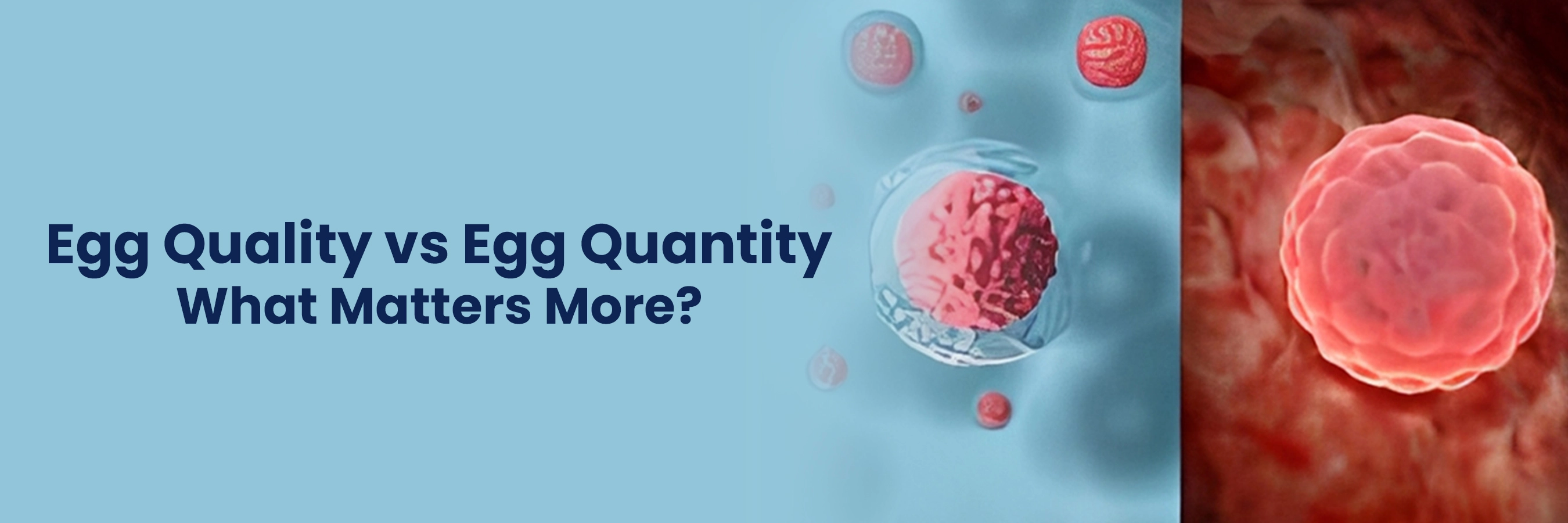
Egg Quality vs Egg Quantity: What Matters More for Fertility?
In the course of pregnancy planning, women frequently raise the question as to which of the two factors, egg quality or egg quantity, is more decisive in the success of the whole process. This is a frequent worry that couples face when trying to conceive and especially the more the age, lifestyle and health problems start to affect their reproductive capacity.
Grasping the differences between egg quality and egg quantity will lead to better decisions regarding your fertility path. Consulting fertility professionals usually highlight that both features are important but each one plays its own unique role in conception. This is often the key discussion in understanding egg quality vs egg quantity.
Understanding Egg Quality and Fertility
When talking about egg quality and fertility, we basically are referring to the genetic health and the structural fitness of the egg. A healthy egg will more definitely be the one to take the sperm, go to the next stages of a viable embryo, implant in the uterus, and eventually give birth to a healthy baby. Therefore, this is the main reason why fertility specialists highlight that fertility and egg quality are the two most influential factors mainly from the age of 30 and onwards.
Egg quality and fertility become more apparent with aging as the mitochondria present in the eggs become weaker by old age. This may also result in an increased risk of chromosomal abnormalities, which could be the reason for both a lack of implantation and miscarriage. Women in their late 30s and early 40s might still have eggs, but the probability of those eggs being genetically normal is reduced by nature. Thus, Medicover Fertility urges that ladies get their fertility checked at the earliest time if they are going to have kids later.
Get a second opinion from trusted experts and makeconfident, informed decisions.
Get Second OpinionNot sure where to start?
Talk to a patient care advisor — free, confidential, 24/7. We'll match you to the right specialist and book your appointment in minutes.
Egg Quality vs Egg Quantity: Which Matters More?
When comparing, the factors of egg quality and egg quantity should both be given equal importance, nevertheless, the latter is assessed by different ways. The first mentioned term quantity to the eggs is the amount of usable eggs that can be obtained, whereas egg quality illustrates the likelihood of the eggs being healthy and thus resulting in a pregnancy.
Simply, quantity is a measure of opportunity, while quality is a measure of potential. Knowing the difference between egg quality and egg quantity can be a great support to couples in the setting of achievable goals and fertility planning
How Egg Quantity Affects Fertility:
- The larger the count of eggs, the more chances of ovulation.
- Usually, women with good ovarian reserves can be treated more effectively.
- Egg quantity naturally dwindles with age.
How Egg Quality Influences Fertility:
- Eggs of good quality are more likely to get fertilized and produce healthy embryos.
- Poor quality eggs can result in fertilization not taking place or miscarriage.
- Egg quality has a strong connection with age and lifestyle factors.
Why Both Matter:
- A younger woman with fewer eggs can still get pregnant if the sperm quality is good.
- And vice versa, a woman with many eggs may still have difficulties if the egg quality is poor.
Age and Quality of Eggs: Why Age Matters
- Age is one of the most influential factors that impacts egg quality and overall fertility.
- As women age, the mitochondria contained within the eggs that supply energy begin to reduce their effectiveness.
- When mitochondrial power decreases the eggs may have difficulty properly dividing and will increase the likelihood of chromosomal abnormalities.
- Any woman considering delaying pregnancy should understand how strongly age is linked to a decline in egg quality.
- Even with the advances in fertility treatments, age remains the strongest indication of success for any type of reproductive technology.
- This is one reason that many women in their 20s and 30s are freezing their eggs as a precautionary step to ensure future ability to conceive.
- Freezing of eggs is generally most effective when a woman has a healthy ovarian reserve (her ability to produce a sufficient amount to divide). Therefore, she is able to freeze higher quality eggs.
Ovarian Reserve and Fertility: What You Need to Know
There is a clear relationship between ovarian reserve and fertility: the larger the stock of eggs, the greater the chances of the body releasing a healthy egg. However, it is important to remember that ovarian reserve reflects only the number of eggs, not their quality, which is why many women consider fertility preservation to safeguard their reproductive potential for the future.
Having a low ovarian reserve does not rule out the possibility of getting pregnant. It just implies that you may need plasticity in your planning, making changes in your lifestyle, or possibly going through fertility treatments depending on your goals. Infertility doctors frequently apply both AMH and AFC evaluations to come up with the individual plans for the patients, particularly for women who are going to do IVF.
How Egg Health Influences Conception
The health of eggs is critical in all steps of conception - egg fertilization through embryonic development. Egg health and conception are a relevant subject for couples hoping to better understand the process. Healthy eggs produce strong embryos and higher rates of pregnancy. You can influence better egg health through lifestyle such as a balanced diet, adequate sleep, exercise, and reduced stress.
Balancing Quality and Quantity for the Best Outcome
When examining egg quality or egg quantity, both should be examined together. Egg quality helps you have a better chance of a successful pregnancy, and egg quantity allows for more chances of natural conception or success rates in IVF. Regardless of fertility status, balancing quality and quantity is important - particularly for women in their 30s and beyond.
At Medicover Fertility, the fertility experts frequently underline the need for early intervention. It doesn't matter if you are in the middle of your reproductive journey or if you are still only planning to have children in the distant future, or even if you are simply trying to get pregnant; your awareness about the egg quality, egg quantity, and overall reproductive health will equip you with the right knowledge and tools to make the best decision that fits your lifestyle.
While the patient's journey to parenthood is often affected by the quality of the eggs and their fertility, and also by the number of eggs and their fertility, they are still along the same path and should be treated as such. One gets some power over one's reproductive future by comprehending the interplay of the quality of the eggs, the quantity of the eggs and the age and ovarian reserve.
Early assessment is very important when you are thinking about fertility evaluation or treatment. It allows you to know very important things like egg quality vs egg quantity, it raises your chances of getting pregnant, and it is a way of making sure you get all-round support from experts with state-of-the-art technology.
Your health is everything - prioritize your well-being today.
Schedule Your AppointmentFrequently Asked Questions
Egg quality describes how healthy and genetically normal an egg is, while egg quantity refers to how many eggs remain in the ovaries.
Yes, many women with low egg quantity conceive naturally if the egg quality is still good.
Medicover Fertility offers advanced AMH, AFC, and ultrasound assessments to help women clearly understand their reproductive potential.
Couples prefer Medicover Fertility for its expert specialists, personalized care, and state-of-the-art reproductive technology.
- Cardiology
- Case Studies
- Dermatology
- Endocrinology
- ENT
- Fertility
- Gastroenterology
- General
- General-Medicine
- Gynecology
- Hematology
- Infectious-Diseases
- Medical News
- Neurology
- Oncology
- Ophthalmology
- Orthopedics
- Pediatrics
- Procedure
- Public-Health
- Pulmonology
- Radiology
- Second Opinion
- Urology
- Wellness
- Woman-and-child
Related Blogs
Still have questions? Speak with our experts now!
040-68334455


Feeling unwell?
Book Doctor Appointment in 30 Sec
