 Call
Call Patient Reports
Crohn's Disease: What It Is, Symptoms, Causes & Treatment
Written by Medicover Team and Medically Reviewed by Dr A Venkateshwar Rao , gastroenterologists-medical
Table of Contents
Crohn's disease is a chronic inflammatory bowel disease (IBD) that causes inflammation in the digestive tract. It can lead to symptoms such as abdominal pain, diarrhea, fatigue, weight loss, and digestive complications over time.
What are the Different Types of Crohn's disease?
Crohn's disease is classified into five categories, each with a set of symptoms.
Ileocolitis
It is an inflammatory disease that affects the end of the small intestine (ileum) and a section of the large intestine (colon). Ileocolitis patients may have symptoms such as:
- Diarrhea
- Substantial weight loss
- Abdominal ache or cramps in the lower and middle quadrants.
Ileitis
It is inflammation of the small intestine's final portion (ileum). Ileitis symptoms are similar to those of ileocolitis. Ileitis patients may sometimes suffer from fistulas (inflammatory abscesses) inside the lower-right belly. Symptoms include:
- Diarrhea
- Weight loss
- Cramping
- Abdominal pain
Gastroduodenal Crohn's disease
It damages the stomach and the first few inches of the small intestinal tract (duodenum). Patients may vomit if small sections of their intestine get clogged with gastroduodenal Crohn's disease. This is due to inflammation in the intestine. Its symptoms include -
- Loss of appetite
- Nausea
- Loss of weight
- Vomiting
Jejunoileitis
It involves inflammation of the middle section of the small intestine (jejunum). Patients with jejunoileitis may have the following symptoms:
- Cramping after eating
- Fistulas
- Diarrhea
- Stomach pain that might be intense at times
Granulomatous Colitis
It involves inflammation of only the colon. It can result in the formation of fistulas, ulcers, and abscesses around the anus. It also includes the following symptoms:
- Skin lesions
- Joint discomfort
- Diarrhea
- Rectal hemorrhage
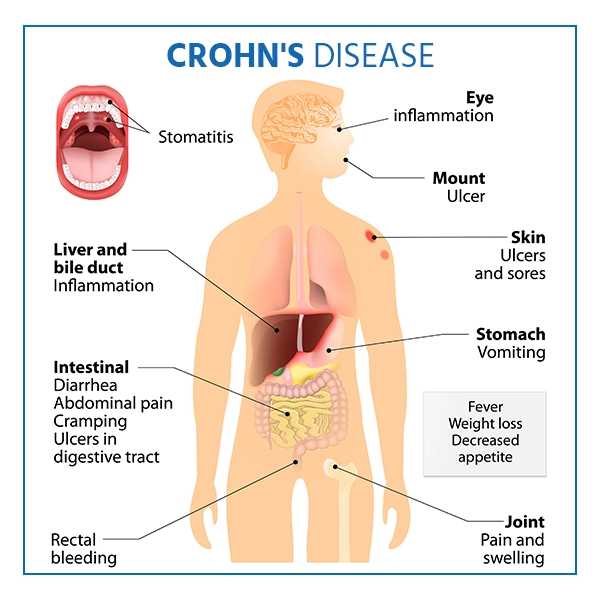
What are the Causes and Risk Factors of Crohn's Disease?
The precise cause of Crohn's disease is unknown. Previously, diet and stress were suspected to cause this disease. But doctors now know that these factors may only worsen the disease and not cause it.
Its development is most likely influenced by a number of variables, including inheritance and a dysfunctional immune system.
- The immune system : A virus or bacterium could cause Crohn's disease, but scientists have yet to uncover such a trigger. When your immune system attempts to fight off the invading microbe, an aberrant immunological reaction causes the immune system to attack digestive tract cells as well.
- Heredity : Crohn's disease is much more common in people who have a family member with this condition. Therefore, genes may have a role in predisposing people to this disease. However, most Crohn's disease patients do not have a family history of the condition.
Risk factors
Crohn's disease risk factors may include:
- Age: Crohn's disease can strike at any age, but it is most likely to strike at a young age.
- Ethnicity: Although Crohn's disease can affect people of any ethnicity, whites are at the highest risk, particularly those of Eastern European (Ashkenazi) Jewish origin.
- Family background: If you have a first-degree relative suffering with Crohn's disease, including a parent, brother, or child, you are at a higher risk.
- Smoking cigarettes: Smoking cigarettes is the most significant modifiable risk factor for Crohn's disease.
- Nonsteroidal anti-inflammatory drugs (NSAIDs): Naproxen sodium (Aleve),Ibuprofen (Advil, Motrin IB, and others), diclofenac sodium, and other drugs can increase the risk of Crohn's disease.
When Should You See a Doctor for Crohn's Disease?
Consulting a gastroenterologist or general physician is important if you experience persistent digestive symptoms or signs that may indicate Crohn's disease.
- Persistent abdominal pain
- Blood in the stool
- Nausea or vomiting
- Chronic diarrhea that does not improve with over-the-counter treatments
- Fever lasting more than one or two days without a known cause
- Unexplained weight loss
Find Gastroenterologists-medical for Crohns Disease Treatment Near You
- Doctor for Crohns Disease in Hyderabad - Hitech City
- Doctor for Crohns Disease in Hyderabad - Financial District
- Doctor for Crohns Disease in Secunderabad
- Doctor for Crohns Disease in Bengaluru
- Doctor for Crohns Disease in Navi Mumbai
- Doctor for Crohns Disease in Pune
- Doctor for Crohns Disease in Vizag
- Doctor for Crohns Disease in Nashik
- Doctor for Crohns Disease in Chh.Sambhajinagar
- Doctor for Crohns Disease in Kurnool
- Doctor for Crohns Disease in Vizianagaram
- Doctor for Crohns Disease in Nellore
- Doctor for Crohns Disease in Kakinada
- Doctor for Crohns Disease in Warangal
- Doctor for Crohns Disease in Karimnagar
- Doctor for Crohns Disease in Chandanagar
- Doctor for Crohns Disease in Nizamabad
- Doctor for Crohns Disease in Srikakulam
What are the Symptoms of Crohn's Disease?
Crohn's disease symptoms are frequent and they appear gradually. Certain symptoms could also worsen with time. Rarely, the Crohn's disease symptoms appear suddenly and rapidly.
Some of the initial symptoms of Crohn's disease include:
- Diarrhea
- The cramping in the abdomen
- There is bleeding in your stool
- Fever
- Fatigue
- Appetite suppression
- Loss of weight
- After a bowel movement, you have the feeling that your bowels are not empty.
- Feeling to urinate frequently
It's possible to confuse these symptoms with those of other ailments, like food poisoning, stomach distress, or an allergy. If either of these symptoms persists, you should consult a doctor.
How is Crohn's Disease Diagnosed?
Typically, doctors do not use a single test to diagnose Crohn's disease. Various tests may be required to confirm the diagnosis. In addition, your doctor will ask you about your health and family history, as well as do a physical examination.
The following test methods may be used to confirm the diagnosis:
- Blood and stool tests
- Biopsy
- Sigmoidoscopy, which includes inspecting the lower colon using a short, elastic tube-like instrument called a sigmoidoscope.
- Colonoscopy which involves inspecting the colon with a flexible, tube-like instrument called a colonoscope.
- Endoscopy is a procedure that involves sending a long, thin, flexible probe known as an endoscope down the esophagus to the stomach to examine the top portion of the gut.
- A CT scan or barium enema X-ray may be used to detect abnormalities in the bowel.
- Magnetic resonance imaging (MRI) is done to observe a fistula near the anal area or the small intestine.
What are the Treatment Options for Crohn's Disease?
There is no cure for Crohn's disease. The goal of treatment is to reduce inflammation in the intestines, avoid symptom flare-ups, and maintain remission.
Crohn's disease is treated by a gastroenterologist using medications, bowel rest, and surgery.
Medicines
Various drugs are used to treat Crohn's disease by reducing the inflammation. They include anti-inflammatory drugs, immune system suppressors, biologics for Crohn's disease, and antibiotics.
Some other remedies include anti-diarrheals, pain relievers, vitamins and supplements, and nutritional therapy.
Bowel rest
It includes consuming only certain liquids and not drinking or eating anything. This method allows the intestine to rest. It is done if the disease symptoms are severe.
Surgery
The doctor may suggest surgery if medications and other therapies do not relieve the Crohn's disease symptoms. Surgery provides only temporary relief because the disease can reappear again.
The best treatment plan includes surgery with the intake of medicines to reduce the risk of recurrence.
The treatment plan will be determined by:
- Where is the inflammation?
- The gravity of the problem
- Any complexities
- A person's reaction to prior treatments
Some people can live for many years without having any symptoms. Remission of Crohn's disease varies so significantly that it can be difficult to predict how effective treatment will be and how long remission will persist.
Your health is everything - prioritize your well-being today.
 Consult Crohns Disease Doctors Today
What Is the Recovery Process After Crohn's Disease Treatment?
Recovery from Crohn's disease focuses on controlling symptoms, reducing flare-ups, and maintaining long-term remission.
Follow-Up Care
- Regular check-ups with a gastroenterologist
- Periodic blood tests or colonoscopy to monitor inflammation
- Extra care for patients on immunosuppressants or biologics
Lifestyle & Diet Tips
- Eat small, soft meals during flare-ups
- Avoid spicy, oily, and high-fibre foods
- Stay hydrated and take prescribed medicines without skipping
- Quit smoking and manage stress through yoga or meditation
- Track food triggers with a symptom diary
Long-Term Outlook
With the right treatment, many live in remission for long periods. Early care helps avoid complications like fistulas, malnutrition, or bowel blockage.
What Precautions Can Help Prevent Crohn's Disease?
Prevention
- Don't smoke, it worsens symptoms
- Eat a balanced diet; avoid known triggers
- Stay active and manage stress
- Get early screening if you have digestive issues or family history
Complications if Untreated
- Intestinal blockage
- Nutrient deficiencies
- Fistulas and chronic diarrhoea
- Increased risk of colon cancer
Dos and Don'ts
Crohn's disease is a type of inflammatory bowel disease (IBD) that includes symptoms like diarrhea, abdominal pain, weight loss, and fever. No exact cure is known and it can be diagnosed through blood and stool tests, colonoscopy, endoscopy, and medical imaging techniques.
| Do's | Don'ts |
|---|---|
| Try meditation, yoga. | Smoking and having tobacco products. |
| Be alert for the symptoms. | Stay away from multivitamins. |
| Take dietician advice. | Eat processed foods, refined sugar, dairy products, coffee, and alcohol. |
| Stay hydrated. | Drink less water. |
| Keep an emergency kit ready. | Eat large meals. |
The disease could be taken care of with the help of medications and surgery. Follow the do's and don'ts for Crohn's disease because it can help to prevent the severity of the symptoms and keep the disease under control.
Frequently Asked Questions
1. Is Crohn's disease the same as IBS?
No. IBS affects bowel function but doesn't cause inflammation or damage. Crohn's is an inflammatory condition that can lead to serious complications.
2. Can Crohn's disease affect areas outside the gut?
Yes, it can affect the skin, joints, eyes, and liver. These extra-intestinal symptoms may occur during flares or be chronic.
3. Can Crohn's disease be life-threatening?
While not usually fatal, severe cases or complications like intestinal blockage, infection, or malnutrition can be serious if untreated.
4. Is surgery required for Crohn's disease?
Not always. Surgery is needed when medications don't work or complications arise, like strictures, fistulas, or abscesses.
5. Can children get Crohn's disease?
Yes, Crohn's can begin in childhood or adolescence. Early diagnosis helps manage growth, nutrition, and long-term health.
6. Can I lead a normal life with Crohn's disease?
Yes. With good medical care and symptom control, many people live full, active lives, including working, traveling, and exercising.
7. How often should I see my doctor for Crohn's?
Regular check-ups are key, usually every 3-6 months or during flare-ups, to monitor your condition and adjust treatment as needed.


