 Call
Call Patient Reports
- Cardiology 84
- Dermatology 45
- Endocrinology 33
- ENT 16
- Fertility 190
- Gastroenterology 78
- General-Medicine 81
- Gynecology 80
- Hematology 19
- Infectious-Diseases 33
- Neurology 52
- Oncology 34
- Ophthalmology 23
- Orthopedics 69
- Pediatrics 31
- Procedure 23
- Public-Health 144
- Pulmonology 59
- Radiology 8
- Urology 68
- Wellness 161
- Woman-and-child 77
- 1758
- 3.7 Minute
Written by Medicover Team and Medically Reviewed by Dr Sanjay Prasad Hegde, Senior Consultant Orthopedic, Joint Replacement, Sports Medicine and Arthroscopy
Debunking the Arthritis Myths by Orthopedics in Bangalore
Arthritis is a group of conditions that affect the joints in different ways. Some types are caused by wear and tear (osteoarthritis). Others are autoimmune (rheumatoid arthritis) and require early medical attention.
Arthritis myths and half-truths can cause anxiety and delay proper care. You may hear that arthritis only affects the elderly, that exercise always makes joints worse, or that diet alone can cure it. Those ideas are common, but they miss the point.
This article lists common, real-world arthritis myths that people still believe. Each myth is followed by a clear, evidence-based fact and a short practical note so you know what to do next. In this article, we dispel these myths with the expertise of the best arthritis hospital in Bangalore.
Common Arthritis Myths and Facts
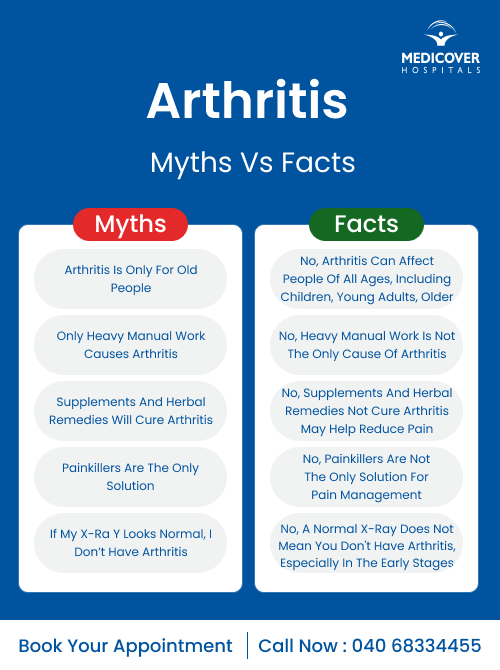
Myth 1 - "Arthritis is only for old people"
Fact: Arthritis can affect people of any age. Some forms begin in childhood or adolescence. Osteoarthritis becomes more common with age, but autoimmune types (such as rheumatoid arthritis) can start much earlier. If you have persistent joint pain, stiffness, swelling, or decreased function, don't just assume it's just old age, seek professional evaluation.
Myth 2 -"Exercise will make arthritis worse"
Fact: Proper exercise is one of the best ways to manage many types of arthritis. Strengthening muscles, improving flexibility, and maintaining a healthy weight can reduce joint stress and pain. Programs are designed according to the diagnosis and symptoms. Ask for a guided exercise plan from orthopedic doctors in Bangalore to keep activities safe and effective.
Myth 3 - "Only heavy manual work causes arthritis"
Fact: Working with your hands increases the risk of certain joint wear and tear problems, but many other factors, such as genetics, obesity, previous joint injury, inflammation caused by autoimmune disease, and lifestyle, are important. Tasks such as repetitive posture or sitting all day can also contribute to symptoms.
Get a second opinion from trusted experts and makeconfident, informed decisions.
Get Second OpinionNot sure where to start?
Talk to a patient care advisor — free, confidential, 24/7. We'll match you to the right specialist and book your appointment in minutes.
Myth 4 - "Supplements and herbal remedies will cure arthritis"
Fact: No single supplement can cure arthritis. Some supplements may help (for example, when vitamin D is deficient), and some dietary changes can reduce inflammation. But supplements are not a substitute for adjuncts, medical evaluation, and proven treatments. Discuss supplements with a rheumatologist to avoid interactions and unnecessary costs.
Myth 5 - "If my X-ray looks normal, I don’t have arthritis"
Fact: In the early stages, inflammatory arthritis may not show up on X-rays. Blood markers, MRI, and careful clinical assessment often identify problems before changes are visible on X-rays. Clinical judgment is important. If symptoms persist despite normal X-rays, ask your doctor for further evaluation or imaging, where appropriate.
Myth 6 - "Cold, damp weather causes arthritis to worsen"
Fact: Scientific evidence is mixed. Some people report increased pain with weather changes, while others do not. Individual experience is different. There’s no reliable way to change the weather, but staying warm, active, and following treatment plans helps manage symptoms.
Myth 7 - "Joint replacement always solves all joint problems"
Fact: Not everyone is eligible for joint replacement, and it has limitations. Joint replacement (hip, knee, shoulder) is effective for many people with severe, persistent symptoms. It can reduce pain and improve function in well-selected patients.
Myth 8 - "Arthritis always means long-term disability"
Fact: Many people with arthritis lead active, productive lives with the right combination of treatments, medications, physiotherapy, lifestyle changes, injections, or surgery when needed.
Myth 9 - "Painkillers are the only solution"
Fact: Pain relief can help, but comprehensive care is extensive. Disease-modifying medications for inflammatory types, physiotherapy, weight management, activity modification, and sometimes injections or surgery are part of modern care. Over-reliance on pain relief without addressing the underlying cause can be harmful.
Myth 10 - "All arthritis types are the same and treated the same way"
Fact: Arthritis is an umbrella term. Osteoarthritis, rheumatoid arthritis, psoriatic arthritis, gout, and juvenile arthritis have different causes and treatments. Accurate diagnosis directs effective therapy.
Your health is everything - prioritize your well-being today.
Schedule Your Appointment
Frequently Asked Questions
Osteoarthritis is caused by the gradual wear and tear of the joints over time. Rheumatoid arthritis is an autoimmune condition where the immune system attacks healthy joint tissues, causing inflammation.
Yes. Regular low-impact exercises like walking, cycling, and swimming help reduce stiffness and improve joint mobility. Exercise also strengthens the muscles around joints, which reduces pain.
You should see a specialist when joint pain lasts for more than a few weeks, affects daily activities, or is accompanied by swelling or morning stiffness.
Joint injections are generally safe when used appropriately. They are recommended to reduce pain and inflammation when medicines and physiotherapy are not giving enough relief.
Excess weight puts more pressure on knee joints, which speeds up cartilage wear. Losing even a small amount of weight can significantly reduce knee pain and improve movement.
Yes. Juvenile idiopathic arthritis affects children and teenagers. Timely treatment helps control inflammation and protects growing joints.
Some supplements, like omega-3 fatty acids or vitamin D, may support joint health, but they cannot replace medical treatment.
Joint replacement removes the damaged joint surfaces and reduces arthritis pain in that joint. However, arthritis can still occur in other joints if risk factors remain.
Mostly yes, but some forms, like rheumatoid arthritis can also cause fatigue, fever, and general weakness.
Rheumatoid arthritis and gout are considered among the most painful. They cause intense inflammation that can flare suddenly and severely.
Common myths include that only old people get RA, that diet alone can cure it, and that exercise makes RA worse.
Myths include avoiding all sour foods, milk worsens arthritis, and spices must be stopped. No single food causes arthritis, but a balanced anti-inflammatory diet supports joint health.
Common myths are that it happens only with age, nothing can help once OA starts, and exercise damages joints.
- Cardiology
- Case Studies
- Dermatology
- Endocrinology
- ENT
- Fertility
- Gastroenterology
- General
- General-Medicine
- Gynecology
- Hematology
- Infectious-Diseases
- Medical News
- Neurology
- Oncology
- Ophthalmology
- Orthopedics
- Pediatrics
- Procedure
- Public-Health
- Pulmonology
- Radiology
- Second Opinion
- Urology
- Wellness
- Woman-and-child
Related Blogs
Still have questions? Speak with our experts now!
040-68334455


